
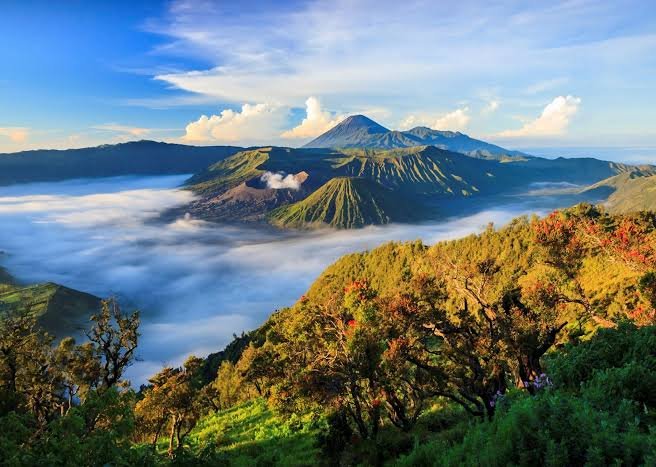
Introduction to Mount Bromo
Mount Bromo is one of the most famous and beautiful volcanoes in Indonesia. Located in East Java, this remarkable mountain attracts visitors from around the world because of its dramatic volcanic landscape, spectacular sunrise views, vast sea of sand, and unique natural environment. Mount Bromo is part of the Bromo Tengger Semeru National Park, a protected natural area known for its volcanic mountains, green hills, traditional villages, and diverse wildlife.
Standing at approximately 2,329 meters above sea level, Mount Bromo is not the tallest mountain in Indonesia, but it is certainly one of the country’s most recognizable natural landmarks. Its wide volcanic crater, constantly changing volcanic landscape, and surrounding mountains create an unforgettable destination for nature lovers, photographers, hikers, and adventure travelers.
The name Bromo comes from Brahma, one of the principal gods in Hinduism. The mountain has deep cultural and spiritual importance for the Tenggerese people, who have lived in the surrounding region for generations. Their traditions, religious ceremonies, and connection with the mountain make Mount Bromo more than simply a geological attraction.
This complete Mount Bromo travel guide explores its location, geographical features, geological history, climate, wildlife, cultural significance, tourism opportunities, and environmental importance.
1. Where Is Mount Bromo Located?
Mount Bromo is located in East Java, Indonesia, within the Bromo Tengger Semeru National Park. The mountain lies in the Tengger region, an area surrounded by several volcanic peaks and dramatic highland landscapes.
Indonesia is part of the Pacific Ring of Fire, a region containing numerous active volcanoes and frequent earthquakes. Its geographical position has created many impressive volcanic landscapes, and Mount Bromo is one of the best-known examples.
The mountain is surrounded by several settlements and highland communities. Popular access areas include Cemoro Lawang, Ngadisari, and nearby villages in the Probolinggo region.
The national park covers a large area of volcanic terrain, grasslands, forests, and mountainous ecosystems. Mount Bromo is located inside an enormous volcanic caldera known as the Tengger Caldera.
Visitors usually reach the region through cities such as Malang, Probolinggo, or Surabaya before continuing toward the national park.
2. Height and Physical Features of Mount Bromo
Mount Bromo rises approximately 2,329 meters above sea level. Although other Indonesian mountains are considerably taller, Bromo is famous for its distinctive shape and location inside a massive volcanic landscape.
The mountain has a relatively small volcanic cone compared with the surrounding caldera. Its summit contains an active crater that produces volcanic gases and occasional ash emissions.
One of the most remarkable features is the enormous sea of sand surrounding the volcano. This landscape, known as the Segara Wedi, consists of volcanic sand and ash deposited through geological processes.
The mountain’s landscape includes:
- A volcanic summit and crater.
- Dark volcanic sand plains.
- Steep volcanic slopes.
- Surrounding mountain ridges.
- Grass-covered hills.
- Rocky volcanic formations.
- Wide panoramic viewpoints.
These features make Mount Bromo one of the most visually distinctive volcanic destinations in Southeast Asia.
3. The Geological History of Mount Bromo
Mount Bromo has a fascinating geological history connected to the formation of the Tengger volcanic complex.
Millions of years of volcanic activity, tectonic movement, and geological changes have shaped the region. The interaction of tectonic plates beneath Indonesia contributes to the formation of magma, which can rise toward the Earth’s surface and create volcanic eruptions.
The Tengger Caldera developed through major volcanic processes involving earlier volcanic structures. Over time, repeated eruptions and geological changes transformed the region into the enormous caldera visible today.
Mount Bromo developed within this volcanic environment.
Its present shape reflects repeated periods of volcanic activity. Lava, volcanic ash, rocks, and other materials have contributed to the mountain’s formation.
The geological landscape continues to change because Mount Bromo remains an active volcano.
Scientists study the mountain to understand volcanic processes, monitor its activity, and improve public safety.
4. Why Is Mount Bromo an Active Volcano?
Mount Bromo is considered an active volcano because it has experienced repeated eruptions and continues to show signs of volcanic activity.
An active volcano is one that has erupted during recorded history or displays geological evidence of continuing activity.
Mount Bromo has a history of eruptions involving volcanic ash, gases, and other volcanic materials.
The volcano’s activity is monitored by Indonesian geological authorities. Monitoring systems help scientists observe changes in volcanic conditions and communicate potential hazards.
Important signs of volcanic activity include:
- Changes in earthquake activity.
- Gas emissions.
- Changes in crater conditions.
- Increased volcanic tremors.
- Ash emissions.
- Changes in ground temperature.
These observations help authorities evaluate volcanic conditions and determine appropriate safety measures.
Visitors should always follow official warnings and restrictions because access to the crater area can change according to volcanic activity.
5. The Famous Sea of Sand
One of the most extraordinary attractions surrounding Mount Bromo is the Sea of Sand.
Known locally as Segara Wedi, this vast sandy area covers the floor of the Tengger Caldera.
The landscape appears almost like a desert surrounded by mountains. Dark volcanic sand stretches across the region, creating a dramatic contrast with the surrounding green hills and volcanic peaks.
The sea of sand was formed through volcanic activity over long periods.
Volcanic ash, broken rocks, and other materials accumulated in the caldera, creating the unusual terrain.
Visitors can explore designated areas of this landscape and enjoy its unique scenery.
The Sea of Sand is particularly impressive during sunrise and early morning, when changing sunlight creates dramatic shadows across the volcanic landscape.
It is one of the main reasons Mount Bromo is internationally recognized as a remarkable natural destination.
6. Mount Bromo and the Tengger Caldera
Mount Bromo is located within the Tengger Caldera, one of the most spectacular volcanic features in East Java.
A caldera is a large volcanic depression formed when a volcanic structure collapses following major geological activity.
The Tengger Caldera contains several volcanic features, including Mount Bromo and Mount Batok.
Mount Batok is especially recognizable because of its steep, symmetrical shape and vegetation-covered slopes.
The surrounding caldera walls create a natural boundary around the volcanic landscape.
From elevated viewpoints, visitors can see several mountains rising from the caldera floor.
This combination of mountains, volcanic sand, and open landscapes makes the region an important destination for geological tourism.
7. The Famous Mount Bromo Sunrise
Sunrise at Mount Bromo is one of the most popular natural experiences in Indonesia.
Every year, thousands of visitors travel to the region to see the first sunlight illuminate the surrounding mountains.
Popular viewpoints include Mount Penanjakan, King Kong Hill, and other designated viewing areas.
During the early morning, the surrounding landscape may appear covered in mist. As the sun rises, the volcanic peaks gradually become visible.
The changing colors of the sky create a spectacular atmosphere.
Visitors often photograph Mount Bromo with Mount Batok and Mount Semeru in the background.
Mount Semeru, Indonesia’s highest volcano on Java, provides an impressive distant background to the Bromo landscape.
The sunrise experience is especially popular among landscape photographers because the scenery changes dramatically with the morning light.
However, sunrise viewing requires preparation because temperatures can be cold at higher elevations.
8. Mount Penanjakan: One of the Best Viewpoints
Mount Penanjakan is among the most famous viewpoints overlooking Mount Bromo.
Located at a higher elevation than the surrounding caldera floor, it provides panoramic views of the volcanic landscape.
From this viewpoint, visitors can observe Mount Bromo, Mount Batok, and Mount Semeru.
The area is particularly popular before sunrise.
Many visitors arrive early to secure a suitable viewing position.
The panoramic scenery makes Penanjakan an important stop for tourists visiting the Bromo region.
Weather conditions influence visibility, so clear mornings generally provide the best views.
9. King Kong Hill and Other Viewpoints
King Kong Hill is another popular viewpoint near Mount Bromo.
It offers beautiful views of the Tengger Caldera and surrounding volcanic peaks.
Other viewpoints in the region include locations along the caldera rim and designated observation areas.
Each viewpoint provides a different perspective of the landscape.
Some offer wide panoramic views, while others provide closer views of the volcanic peaks.
Visitors should use established viewing locations and follow local instructions to protect the natural environment.
10. Mount Bromo and Mount Semeru
Mount Bromo and Mount Semeru are two important volcanic landmarks in East Java.
Although they are part of the same national park, they have very different geographical characteristics.
Mount Bromo is famous for its relatively accessible volcanic crater and surrounding sea of sand.
Mount Semeru is much taller, reaching approximately 3,676 meters above sea level.
Semeru is the highest mountain on Java and an important feature of the region’s volcanic landscape.
On clear mornings, visitors at Mount Bromo viewpoints can sometimes see Semeru rising in the distance.
The combination of these two volcanoes creates one of the most recognizable mountain views in Indonesia.
11. Climate and Weather at Mount Bromo
Mount Bromo experiences a tropical highland climate.
Although Indonesia is generally associated with warm tropical weather, the higher elevation of the Bromo region creates cooler temperatures.
Weather conditions vary according to season, elevation, and local atmospheric conditions.
Early mornings can be particularly cold.
Visitors may experience temperatures that feel much cooler than those in nearby lowland cities.
The region generally has two main seasons:
Dry Season
The dry season usually occurs from around April to October.
During this period, rainfall is generally lower, and visibility may be better on many mornings.
This season is popular for sightseeing and photography.
Rainy Season
The rainy season generally occurs from around November to March.
Rainfall can make trails slippery and reduce visibility.
Clouds and fog may also affect sunrise views.
However, the surrounding hills can appear greener during and after rainy periods.
Weather conditions can change quickly, so visitors should check forecasts before traveling.
12. Best Time to Visit Mount Bromo
The best time to visit Mount Bromo depends on personal preferences and weather conditions.
Many visitors prefer the dry season because it generally provides more opportunities for clear mountain views.
The months between May and September are often popular for sightseeing.
Early morning is the best time for experiencing the famous sunrise.
Visitors who prefer greener landscapes may enjoy periods following rainfall, although weather can be less predictable.
It is important to remember that the mountain remains an active volcano throughout the year.
Tourism schedules and access restrictions may change according to safety conditions.
Checking official national park information before visiting is strongly recommended.
13. Wildlife Around Mount Bromo
The Bromo Tengger Semeru National Park supports several different ecosystems.
Its landscapes include forests, grasslands, volcanic terrain, and mountainous habitats.
These environments provide homes for different species of plants, birds, and animals.
Wildlife diversity varies according to elevation and habitat.
Some parts of the national park contain forest ecosystems with native Indonesian wildlife.
Bird species are among the important components of the region’s biodiversity.
Small mammals, insects, reptiles, and other animals also contribute to the ecological balance.
Wildlife observation should always be conducted responsibly.
Visitors should avoid feeding animals, disturbing nests, or damaging natural habitats.
Protecting biodiversity is an important responsibility for everyone visiting the national park.
14. Plant Life and Vegetation
The vegetation around Mount Bromo changes according to elevation, soil conditions, and exposure to volcanic activity.
The surrounding highlands contain grasslands, shrubs, forests, and other forms of vegetation.
Some areas are covered by open grassland, creating a striking contrast with the dark volcanic sand.
The famous Teletubbies Hill area is particularly known for its rolling green landscape.
Vegetation can become more noticeable during wetter months.
Higher volcanic areas may have limited plant growth because of exposure, temperature, and soil conditions.
These different habitats contribute to the ecological importance of the national park.
15. Teletubbies Hill
Teletubbies Hill is a beautiful green landscape located in the wider Mount Bromo region.
Its rounded hills and grass-covered slopes create a scenery very different from the dark volcanic sand surrounding the mountain.
The name comes from the resemblance of the rolling hills to landscapes seen in the children’s television program Teletubbies.
The area is popular among tourists and photographers.
During greener periods, the hills provide excellent opportunities for landscape photography.
Visitors can enjoy the scenery while respecting local environmental rules.
The contrast between Teletubbies Hill and the volcanic landscape demonstrates the natural diversity of the Bromo region.
16. The Whispering Sands
Whispering Sands is another interesting natural feature associated with the Mount Bromo landscape.
The name refers to the unusual sounds that can sometimes be produced when wind moves across loose volcanic sand.
The wide sandy environment creates an open landscape where wind conditions can influence the movement of fine particles.
Visitors often include the area in their exploration of the Sea of Sand.
The experience provides another opportunity to understand the natural processes shaping the volcanic environment.
17. The Cultural Importance of Mount Bromo
Mount Bromo has deep cultural significance for the Tenggerese people.
The Tenggerese are an ethnic community living in villages surrounding the volcano.
Their traditions, beliefs, and customs are closely connected with the mountain and the surrounding natural environment.
Hindu traditions play an important role in Tenggerese cultural life.
The mountain is considered sacred by many members of the community.
This spiritual relationship is one reason Mount Bromo is important beyond its geological and tourism value.
Local traditions have been preserved across generations.
Visitors should respect the cultural practices and religious beliefs of the communities living in the region.
18. The Yadnya Kasada Festival
One of the most famous cultural events associated with Mount Bromo is the Yadnya Kasada Festival.
The festival is celebrated by the Tenggerese community.
It is connected with traditional beliefs and stories passed down through generations.
During the ceremony, participants gather at the mountain and take part in religious activities.
Offerings are traditionally presented as part of the ritual.
These offerings may include agricultural products and other ceremonial items.
The festival is an important expression of Tenggerese identity and cultural heritage.
It also attracts visitors interested in Indonesian traditions.
However, the ceremony is primarily a religious event, so visitors should behave respectfully and follow local instructions.
19. The Legend of Roro Anteng and Joko Seger
The cultural history of Mount Bromo includes the traditional legend of Roro Anteng and Joko Seger.
According to local tradition, Roro Anteng and Joko Seger were an important couple associated with the origins of the Tenggerese community.
The legend describes their desire to have children and their connection with spiritual promises.
The story is closely associated with the religious traditions of the region.
It is also connected with the origins of the Yadnya Kasada ceremony.
Although traditional stories are not scientific explanations of volcanic activity, they provide valuable insight into the cultural identity of the Tenggerese people.
The legend remains an important part of the region’s oral heritage.
20. Tourism at Mount Bromo
Tourism is one of the most important economic activities in the Mount Bromo region.
Visitors arrive from different parts of Indonesia and other countries.
The mountain attracts several types of travelers, including:
- Nature lovers.
- Landscape photographers.
- Cultural tourists.
- Adventure travelers.
- Families.
- Students.
- Geological researchers.
The region offers a combination of natural scenery and cultural experiences.
Tourism also supports local businesses, transportation services, accommodation providers, guides, and food vendors.
Responsible tourism can help local communities benefit economically while protecting the natural environment.
21. How to Reach Mount Bromo
Visitors can reach Mount Bromo through several transportation routes.
The most common starting cities include Surabaya and Malang.
From Surabaya
Surabaya is one of the main transportation centers in East Java.
Visitors can travel toward Probolinggo and continue to the Bromo region.
The journey usually involves road transportation.
From Malang
Malang is another popular starting point.
Travelers can arrange transportation through local tour operators or private vehicles.
From Probolinggo
Probolinggo provides access to the northern side of the Bromo region.
Cemoro Lawang is a popular village used as a base for visitors.
Travel times depend on traffic, weather, road conditions, and the selected route.
Visitors should check current transportation arrangements before departure.
22. Cemoro Lawang Village
Cemoro Lawang is one of the most popular villages for visiting Mount Bromo.
It is located near the edge of the Tengger Caldera and offers beautiful views of the surrounding volcanic landscape.
The village has accommodation, restaurants, local shops, and tourism services.
Many travelers stay in Cemoro Lawang before visiting sunrise viewpoints.
Its location makes it a convenient base for exploring Mount Bromo.
Visitors can also learn about local life and the traditions of the Tenggerese community.
The village provides an opportunity to experience the cultural atmosphere of the highland region.
23. Accommodation Near Mount Bromo
The Mount Bromo region offers different types of accommodation.
Options include guesthouses, small hotels, homestays, and mountain-view lodges.
Cemoro Lawang is particularly popular because of its convenient location.
Other travelers choose accommodation in nearby towns and cities.
The best accommodation depends on budget, transportation, and travel preferences.
Visitors planning to see sunrise often prefer staying close to the national park.
During busy tourism periods, booking accommodation in advance can be helpful.
Travelers should also check heating facilities because early mornings can be cold.
24. Food and Local Cuisine
The food culture around Mount Bromo reflects the wider culinary traditions of East Java.
Visitors can find Indonesian dishes in local restaurants and village food stalls.
Popular dishes may include:
- Nasi Goreng.
- Mie Goreng.
- Soto Ayam.
- Bakso.
- Satay.
- Vegetable rice dishes.
- Traditional Indonesian snacks.
Warm drinks are particularly popular during cold mornings.
Local restaurants and small businesses provide convenient dining options for visitors.
Trying regional food is a good way to experience the culture of East Java.
25. Photography at Mount Bromo
Mount Bromo is one of Indonesia’s most photographed natural landmarks.
Its volcanic landscape provides many opportunities for photography.
Popular subjects include the sunrise, sea of sand, volcanic crater, surrounding mountains, and green hills.
Landscape photographers often visit the region early in the morning.
Different lighting conditions create different visual effects.
Sunrise photography can capture warm colors across the mountain peaks.
Clouds and mist may also create dramatic scenery.
Visitors should photograph from safe and permitted locations.
Protecting the environment is more important than reaching an unauthorized viewpoint.
26. Hiking and Outdoor Activities
Mount Bromo attracts visitors interested in outdoor activities.
Popular experiences include exploring designated paths, visiting viewpoints, and walking through permitted areas of the Sea of Sand.
The region offers opportunities to appreciate volcanic landscapes without requiring every visitor to undertake a demanding mountain expedition.
Visitors should understand that Mount Bromo is an active volcano.
Access to certain locations may be restricted depending on volcanic conditions.
It is important to follow park regulations, use approved routes, and respect instructions from local authorities.
Appropriate footwear, warm clothing, drinking water, and weather preparation can improve the experience.
27. Safety Around Mount Bromo
Safety is extremely important when visiting an active volcano.
Mount Bromo can release volcanic gases and ash, and conditions may change without warning.
Visitors should never ignore official restrictions.
Important safety considerations include:
- Check current volcanic alerts before visiting.
- Follow national park instructions.
- Avoid restricted crater areas.
- Do not approach dangerous volcanic openings.
- Wear suitable footwear.
- Prepare for cold weather.
- Carry drinking water.
- Follow local guide instructions.
- Avoid traveling through unfamiliar areas at night.
- Respect temporary closures.
Volcanic activity is unpredictable, and even a popular tourist destination can become dangerous under certain conditions.
Official safety information should always take priority over tour schedules.
28. Environmental Challenges Facing Mount Bromo
Mount Bromo is an important natural environment that faces several environmental challenges.
Tourism can create pressure on the landscape when visitor numbers become high.
Waste, vehicle emissions, soil disturbance, and damage to vegetation are potential concerns.
Volcanic landscapes can be particularly sensitive because vegetation may take a long time to recover.
Environmental management is essential for protecting the national park.
Visitors can help by avoiding littering, using designated routes, respecting wildlife, and following park rules.
Tour operators and local businesses also play an important role in encouraging sustainable tourism.
29. Conservation of Bromo Tengger Semeru National Park
Bromo Tengger Semeru National Park is protected to conserve its natural and cultural heritage.
The park contains important volcanic landscapes, forests, grasslands, and wildlife habitats.
Conservation activities include environmental monitoring, habitat protection, visitor management, and public education.
The national park is also important for scientific research.
Researchers study its geological features, biodiversity, and environmental processes.
Protecting the area requires cooperation among government agencies, local communities, researchers, tourism businesses, and visitors.
Sustainable management can help preserve Mount Bromo for future generations.
30. Mount Bromo and Scientific Research
Mount Bromo provides an important natural laboratory for scientific research.
Geologists study its volcanic structure and eruption history.
Volcanologists monitor its activity to better understand changes in the volcano.
Environmental researchers study how volcanic materials influence soil and vegetation.
Ecologists examine the relationship between different habitats and native species.
The mountain also provides opportunities for studying volcanic landscapes and geological evolution.
Scientific research improves understanding of the region and contributes to public safety.
31. Mount Bromo Compared with Other Indonesian Volcanoes
Indonesia contains many famous volcanoes, including Mount Merapi, Mount Rinjani, Mount Krakatoa, and Mount Semeru.
Each volcano has distinctive characteristics.
Mount Bromo is especially famous for its location within the Tengger Caldera.
Mount Semeru is known for its great height and volcanic activity.
Mount Rinjani is recognized for its impressive crater lake and mountain scenery.
Mount Merapi is one of Indonesia’s well-known active volcanoes.
Mount Krakatoa is internationally famous because of its historical eruptions.
Mount Bromo stands out because its surrounding landscape is unusually accessible from established tourism areas when conditions permit.
32. Interesting Facts About Mount Bromo
Here are some interesting facts about Mount Bromo:
- Mount Bromo is located in East Java, Indonesia.
- Its elevation is approximately 2,329 meters.
- It is an active volcano.
- It is part of Bromo Tengger Semeru National Park.
- The mountain is located inside the Tengger Caldera.
- The surrounding landscape includes a famous Sea of Sand.
- The name Bromo comes from the Hindu god Brahma.
- The Tenggerese community has a strong cultural connection with the mountain.
- Yadnya Kasada is an important traditional festival.
- Mount Penanjakan is a famous sunrise viewpoint.
- Mount Batok is another recognizable volcanic feature in the caldera.
- Mount Semeru can be seen from some viewpoints on clear days.
- The area attracts international photographers.
- The national park contains several different ecosystems.
- The region is one of Indonesia’s most recognizable volcanic tourism destinations.
33. Why Mount Bromo Is Important to Indonesia
Mount Bromo is important to Indonesia for several reasons.
First, it is a major natural landmark that represents the country’s volcanic geography.
Second, it contributes to the tourism economy of East Java.
Third, it has cultural and spiritual importance for the Tenggerese community.
Fourth, it provides opportunities for geological and environmental research.
Finally, it represents the importance of protecting natural landscapes.
The mountain is an example of how geological features, cultural traditions, and tourism can exist together in one region.
34. Responsible Tourism at Mount Bromo
Responsible tourism helps protect the mountain and supports the local communities.
Visitors should follow simple environmental guidelines.
They should carry their waste away, avoid damaging vegetation, and respect cultural sites.
Travelers should also support local businesses when possible.
Using registered guides and following official national park rules can improve both safety and the quality of the visit.
Responsible visitors understand that natural landscapes should be protected rather than treated as disposable attractions.
35. Mount Bromo for International Travelers
Mount Bromo is an important destination for international tourists visiting Indonesia.
Its dramatic scenery offers an experience different from the country’s tropical beaches and coastal resorts.
The volcanic landscape attracts travelers interested in nature, photography, geography, and culture.
International visitors often combine a trip to Mount Bromo with visits to other destinations in East Java.
Travel planning should include transportation, accommodation, weather conditions, and park regulations.
Visitors should also learn a few basic Indonesian expressions to communicate with local residents.
Respect for local traditions can make the experience more meaningful.
36. Mount Bromo During Different Seasons
The appearance of Mount Bromo changes throughout the year.
During the dry season, the landscape may appear dusty and brown, particularly around the Sea of Sand.
The skies can sometimes be clearer, creating good opportunities for photography.
During the rainy season, surrounding vegetation often becomes greener.
Clouds, fog, and rainfall can create a different atmosphere.
Each season offers its own natural beauty.
The choice of travel period depends on weather preferences, visibility, and official access conditions.
37. The Importance of Volcanic Soil
Volcanic materials play an important role in shaping the surrounding environment.
Volcanic ash and weathered rocks can contribute minerals to soil.
Over time, these materials may support vegetation in areas where environmental conditions allow plant growth.
The relationship between volcanic activity and soil development is an important subject in environmental science.
However, volcanic environments can also be affected by ash deposition and other hazards.
The balance between geological activity and ecological recovery makes the Bromo region scientifically interesting.
38. Education and Learning Opportunities
Mount Bromo is an excellent destination for educational activities.
Students can learn about:
- Volcano formation.
- Tectonic plate movement.
- Volcanic eruptions.
- Caldera development.
- Mountain ecosystems.
- Climate and weather.
- Environmental conservation.
- Indonesian cultural heritage.
Teachers and researchers can use the region to explain geological and environmental concepts.
The combination of natural and cultural features makes the national park especially valuable for educational tourism.
39. Mount Bromo in Travel Literature and Photography
Mount Bromo has become an important subject in travel writing and photography.
Its unusual volcanic scenery makes it visually recognizable.
Travel writers often describe its sunrise views, sea of sand, and cultural traditions.
Photographers are attracted by the contrast between dark volcanic terrain and colorful morning skies.
The mountain also appears in many travel documentaries and tourism publications.
Its international popularity has helped introduce the natural beauty of East Java to a wider audience.
40. Challenges for Local Communities
Local communities around Mount Bromo depend on a combination of agriculture, tourism, and other economic activities.
Tourism can provide employment opportunities through accommodation, transport, food services, and guiding.
However, the region also faces challenges.
Volcanic activity can interrupt tourism and affect local livelihoods.
Changing weather conditions may influence agriculture and transportation.
Environmental pressures can also affect traditional ways of life.
Supporting local businesses and protecting cultural traditions are important parts of sustainable tourism development.
41. What Makes Mount Bromo Unique?
Mount Bromo is unique because it combines several remarkable features in one geographical area.
It has an active volcanic crater, a huge caldera, a volcanic sand plain, surrounding mountains, green hills, and a living cultural heritage.
Few destinations offer such a distinctive combination of geology and culture.
Its sunrise scenery is internationally famous.
Its connection with the Tenggerese community gives it additional cultural importance.
The mountain is not simply a tourist attraction; it is part of a much larger natural and human landscape.
42. Travel Preparation for Mount Bromo
Good preparation can make a visit to Mount Bromo more comfortable.
Visitors should check weather forecasts and volcanic alerts before traveling.
Warm clothing is useful because temperatures can be low during early morning hours.
Comfortable footwear is important for walking across uneven terrain.
A small backpack can carry water, snacks, personal items, and other essentials.
Visitors should also check transportation arrangements and accommodation availability.
Most importantly, travelers should follow the latest instructions from national park authorities.
43. The Future of Mount Bromo Tourism
The future of Mount Bromo tourism depends on balancing visitor demand with environmental protection.
The destination is likely to remain popular because of its unique natural scenery and cultural importance.
However, increasing visitor numbers can create pressure on natural resources.
Sustainable tourism planning can help manage these challenges.
Environmental education, responsible transportation, waste management, and cooperation with local communities are important measures.
Protecting the mountain’s cultural and natural heritage should remain a priority.
44. Frequently Asked Questions About Mount Bromo
Where is Mount Bromo located?
Mount Bromo is located in East Java, Indonesia, inside Bromo Tengger Semeru National Park.
How high is Mount Bromo?
Mount Bromo has an elevation of approximately 2,329 meters above sea level.
Is Mount Bromo an active volcano?
Yes. Mount Bromo is an active volcano with a history of eruptions.
Why is Mount Bromo famous?
It is famous for its volcanic crater, sunrise views, Sea of Sand, Tengger Caldera, and cultural significance.
What is the best time to visit Mount Bromo?
The dry season, generally between April and October, is popular for sightseeing. However, weather and volcanic conditions should always be checked.
Can visitors see sunrise at Mount Bromo?
Yes. Sunrise viewpoints such as Mount Penanjakan offer panoramic views of the volcanic landscape when weather and access conditions permit.
What is the Sea of Sand?
The Sea of Sand is a large area of volcanic sand and ash located inside the Tengger Caldera.
What is the Yadnya Kasada Festival?
It is an important traditional religious festival celebrated by the Tenggerese community.
Is Mount Bromo suitable for photography?
Yes. Its volcanic scenery, sunrise views, and surrounding mountains make it a popular destination for photographers.
Is Mount Bromo safe for tourists?
It can be visited safely when official access is permitted and visitors follow volcanic alerts, park restrictions, and local safety instructions.
45. Conclusion
Mount Bromo is one of the most remarkable natural landmarks in Indonesia. Its active volcanic crater, enormous Sea of Sand, surrounding mountains, and spectacular sunrise views make it a unique destination in Southeast Asia.
The mountain is also deeply connected with the traditions and spiritual beliefs of the Tenggerese community. The Yadnya Kasada Festival and local cultural heritage demonstrate the importance of Mount Bromo beyond its physical landscape.
From a geological perspective, the region provides valuable opportunities to study volcanic activity, caldera formation, and environmental development. Its national park also supports important ecosystems and biodiversity.
Tourism has helped introduce Mount Bromo to international visitors while creating economic opportunities for surrounding communities. At the same time, responsible tourism and environmental conservation remain essential for protecting the area.
Whether someone is interested in geography, geology, photography, cultural traditions, or natural landscapes, Mount Bromo offers an extraordinary subject to explore.
Its combination of volcanic beauty, cultural heritage, and ecological importance makes Mount Bromo one of Indonesia’s most unforgettable destinations.
SEO Information
SEO Title: Mount Bromo: Complete Travel Guide, Facts, History, and Natural Beauty
Meta Description: Discover Mount Bromo in Indonesia with this complete guide covering its volcanic history, geography, sunrise views, Sea of Sand, Tengger culture, tourism, and travel information.
Focus Keyword: Mount Bromo
Secondary Keywords:
- Mount Bromo Indonesia
- Mount Bromo travel guide
- Mount Bromo volcano
- Mount Bromo sunrise
- Mount Bromo national park
- Bromo Tengger Semeru National Park
- Mount Bromo facts
- Mount Bromo history
- Mount Bromo tourist attractions
- Sea of Sand Indonesia
Suggested URL Slug: mount-bromo-complete-travel-guide
Suggested Article Category: Mountains and Natural Wonders