
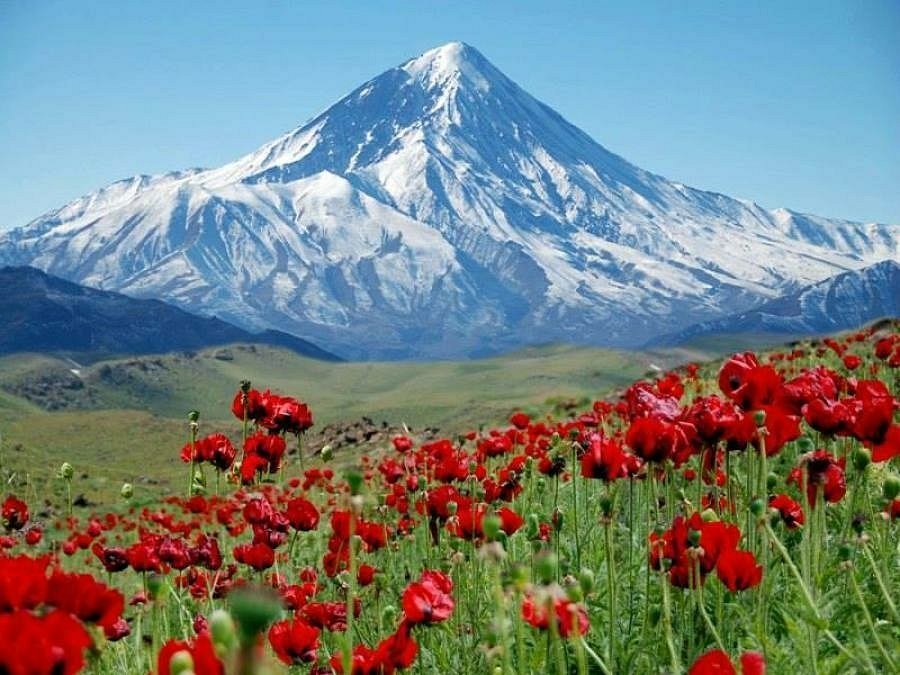
Introduction to Mount Damavand
Mount Damavand is one of the most famous and impressive mountains in the Middle East. Located in northern Iran, this magnificent mountain is the highest peak in the country and the tallest volcano in Asia. Rising dramatically above the surrounding landscapes, Mount Damavand is an important natural landmark, a popular destination for mountaineers, and a symbol of Iranian culture and national identity.
With an elevation of approximately 5,610 meters (18,406 feet) above sea level, Mount Damavand dominates the Alborz Mountain Range. Its snow-covered summit, volcanic history, beautiful valleys, and surrounding natural environments attract visitors, researchers, photographers, and mountain climbers from different parts of the world.
Mount Damavand is not only important because of its height. It also has a fascinating geological history, unique wildlife, cultural significance, and connections to ancient Persian mythology. For centuries, the mountain has appeared in Iranian literature, legends, and traditional stories.
The mountain is located northeast of Tehran, Iran’s capital city, making it relatively accessible compared with many other high mountains around the world. However, climbing Mount Damavand remains a demanding physical challenge because of its considerable elevation, changing weather, steep slopes, and high-altitude conditions.
This comprehensive guide explores Mount Damavand’s location, geography, geological formation, volcanic characteristics, climate, wildlife, vegetation, history, cultural importance, climbing routes, tourism, and environmental significance.
1. Where Is Mount Damavand Located?
Mount Damavand is located in northern Iran, within the Mazandaran Province, in the central part of the Alborz Mountain Range. The Alborz Mountains stretch along the southern coast of the Caspian Sea and create a natural boundary between the northern coastal region and the Iranian plateau.
The mountain is situated northeast of Tehran and can be seen from various locations under suitable weather conditions. Its impressive height makes it one of the most recognizable geographical features in northern Iran.
Mount Damavand stands near several towns and villages, including Polour, Rineh, and Larijan. These settlements serve as important starting points for visitors and climbers traveling toward the mountain.
The surrounding region contains valleys, rivers, mountain slopes, forests, and open grasslands. These landscapes create a diverse natural environment that changes considerably with elevation.
The mountain’s geographical position also influences local weather patterns. Moist air coming from the Caspian Sea interacts with the high mountain terrain, producing different climatic conditions on its northern and southern slopes.
Because of its location, Mount Damavand is an important part of Iran’s natural heritage and a major attraction for domestic and international tourists.
2. Height and Physical Characteristics of Mount Damavand
Mount Damavand reaches approximately 5,610 meters above sea level, making it the highest mountain in Iran.
It is also recognized as the highest volcano in Asia. Its enormous height gives it a commanding presence above the surrounding Alborz Mountains.
The mountain has a broadly conical volcanic shape, although erosion, glacial activity, volcanic deposits, and weathering have modified its original structure over thousands of years.
Its upper slopes are often covered with snow, particularly during winter and spring. Snow can remain near the summit even during warmer months because temperatures decrease significantly with altitude.
The summit area contains volcanic rocks, loose volcanic material, and evidence of past geological activity. A noticeable sulfur smell may occur near certain summit areas because of volcanic gas emissions.
The mountain’s slopes are not uniform. Some sections are relatively gentle, while others contain steep rocky areas, loose volcanic gravel, and difficult terrain.
Several valleys and ridges extend outward from the main volcanic structure. These geographical features influence climbing routes, drainage systems, and the distribution of vegetation.
The combination of height, volcanic structure, and surrounding mountain scenery makes Damavand one of the most remarkable natural landmarks in Asia.
3. Geological Formation of Mount Damavand
Mount Damavand has a long and fascinating geological history connected to the tectonic development of the Alborz Mountain Range.
The Alborz Mountains formed through complex geological processes involving the movement and interaction of tectonic plates. These processes produced folding, faulting, uplift, and volcanic activity over millions of years.
Mount Damavand developed through volcanic activity associated with this geological environment.
The volcano contains different layers of volcanic material, including lava deposits, ash, and other volcanic rocks. These materials accumulated during different periods of volcanic activity.
Scientists study Mount Damavand to understand the volcanic history of northern Iran and the broader geological evolution of the region.
The mountain’s volcanic structure has been shaped by several processes:
- Volcanic eruptions and lava movement.
- Accumulation of volcanic ash and fragmented rocks.
- Weathering caused by temperature changes.
- Erosion from rainfall, snow, and flowing water.
- Freeze-thaw processes in high-altitude environments.
- Glacial and periglacial activity.
These processes have gradually changed the mountain’s surface and surrounding landscapes.
Its geological structure makes Mount Damavand particularly interesting to geologists, volcanologists, and earth science researchers.
4. Is Mount Damavand an Active Volcano?
Mount Damavand is generally classified as a potentially active or dormant volcano.
Although it has not experienced a major historical eruption in modern times, geological evidence indicates that volcanic activity occurred during its development.
The mountain contains fumarolic activity near the summit, where volcanic gases escape through openings in the ground.
Sulfur deposits and gas emissions provide evidence of continuing geothermal processes.
These features are important because they show that Mount Damavand is not simply an extinct mountain formed by ancient geological activity.
However, fumaroles do not automatically indicate that an eruption is approaching. Volcanic activity must be evaluated through scientific monitoring, including measurements of earthquakes, ground deformation, temperature, and gas emissions.
Researchers continue to examine the mountain’s volcanic characteristics to better understand its long-term behavior.
Mount Damavand is therefore an important natural laboratory for studying dormant volcanic systems.
5. Climate and Weather Conditions
Mount Damavand experiences significant climatic differences because of its great elevation.
The lower slopes have relatively moderate mountain conditions, while the upper sections experience extremely cold temperatures, strong winds, and reduced atmospheric pressure.
Winter is particularly harsh. Heavy snowfall, freezing temperatures, and strong winds can make the mountain difficult to access.
Spring brings gradual warming to lower elevations, although snow and cold conditions remain common near the summit.
Summer is generally considered the most favorable season for climbing because temperatures are comparatively warmer and some routes become more accessible.
Autumn brings cooler temperatures, shorter daylight hours, and increasing snowfall at higher elevations.
Weather conditions can change rapidly. A clear morning may be followed by clouds, strong winds, or snowfall later in the day.
The main climatic characteristics include:
- Cold temperatures at high elevations.
- Seasonal snowfall.
- Strong mountain winds.
- Low atmospheric pressure near the summit.
- Significant temperature differences between day and night.
- Changing visibility and cloud conditions.
Visitors should never assume that summer weather in nearby towns represents conditions on the summit.
Understanding mountain weather is essential for anyone exploring Damavand.
6. Snow and Glaciers on Mount Damavand
Snow is one of the most recognizable features of Mount Damavand.
Its upper slopes remain covered with snow for much of the year, creating a beautiful contrast with the darker volcanic terrain.
Snow accumulation depends on seasonal precipitation, wind direction, slope orientation, and temperature.
The mountain also contains small glacier and perennial snow features, although their size and condition vary with climate.
Glacial activity has contributed to the formation of several high-altitude landscape features.
Snow and ice influence the mountain’s water systems because melting snow contributes to streams and seasonal water supplies in surrounding areas.
These water resources are important for nearby communities, agriculture, and natural ecosystems.
Changes in temperature and precipitation can affect snow coverage and the long-term condition of high-altitude ice.
For researchers, Mount Damavand provides an opportunity to study the relationship between volcanic landscapes, snow accumulation, and changing mountain climates.
7. Flora and Vegetation Around Mount Damavand
The vegetation surrounding Mount Damavand changes according to elevation, temperature, soil conditions, and water availability.
At lower elevations, visitors may encounter shrubs, grasses, agricultural vegetation, and patches of woodland.
The northern slopes receive greater moisture from the Caspian Sea and generally support more vegetation than many southern areas.
As elevation increases, trees become less common and are gradually replaced by shrubs, grasses, and alpine plants.
Near the upper mountain, vegetation becomes increasingly limited because of freezing temperatures, strong winds, thin soils, and a short growing season.
Some plant communities are specially adapted to survive difficult mountain conditions.
These adaptations may include:
- Low-growing growth patterns.
- Small leaves that reduce water loss.
- Strong root systems.
- Seasonal growth cycles.
- Resistance to cold temperatures.
- Ability to survive in rocky soil.
The vegetation of Mount Damavand contributes to soil stability and provides food and shelter for different animals.
Protecting these plants is important because high-altitude ecosystems can recover slowly after environmental damage.
8. Wildlife of Mount Damavand
Mount Damavand and its surrounding landscapes support a variety of wildlife.
The Alborz Mountain Range contains different habitats, including forests, grasslands, rocky slopes, and alpine environments.
These habitats support mammals, birds, reptiles, and smaller animal species.
Wildlife distribution depends on elevation, food availability, vegetation, and human activity.
Some mammals associated with the wider Alborz region include wild goats, wild sheep, foxes, wolves, and other mountain-adapted animals.
The Persian leopard is also associated with parts of the Alborz region, although sightings are rare and the species requires extensive protected habitats.
Birdlife includes different species of eagles, falcons, vultures, and smaller mountain birds.
These birds use mountain cliffs and open landscapes for nesting, hunting, and movement.
Smaller animals and insects also contribute to the ecological balance of the region.
Wildlife conservation is important because habitat destruction, pollution, illegal hunting, and increasing human activity can affect animal populations.
Mount Damavand’s natural environment forms part of a wider ecosystem that deserves long-term protection.
9. Mount Damavand in Persian Mythology
Mount Damavand has a special place in Persian mythology and traditional storytelling.
One of the most famous legends connected with the mountain is the story of Zahhak and Fereydun.
According to the Shahnameh, the great Persian epic written by Ferdowsi, Zahhak was a cruel ruler who was eventually defeated by the hero Fereydun.
In the traditional story, Zahhak was chained and imprisoned on Mount Damavand rather than being killed.
This legend gives the mountain an important symbolic meaning in Iranian culture.
Damavand is often associated with resistance against tyranny, freedom, courage, and national identity.
The mountain appears in Persian poetry and literature as a symbol of strength and permanence.
Its impressive shape and commanding position have helped establish its reputation as more than an ordinary geographical feature.
For many Iranians, Mount Damavand represents the country’s historical memory, cultural heritage, and natural beauty.
10. Historical Importance of Mount Damavand
Mount Damavand has been an important geographical and cultural landmark throughout Iranian history.
Its prominence made it a familiar feature of the northern Iranian landscape.
Communities living around the mountain developed agricultural practices, traditional lifestyles, and connections with the surrounding natural environment.
The mountain also became an important subject in Persian literature and artistic traditions.
Over time, interest in scientific exploration and mountaineering increased.
Researchers began examining its volcanic structure, geological features, and environmental conditions.
Mountaineers also became interested in reaching its summit, making it one of the most recognized climbing destinations in Iran.
Today, Damavand represents a combination of historical significance, scientific importance, and outdoor recreation.
11. Mount Damavand as Iran’s Highest Mountain
Mount Damavand holds a special position in Iran’s geography because it is the country’s highest peak.
Its elevation makes it a major destination for experienced mountaineers and outdoor enthusiasts.
The mountain is also an important reference point for understanding the geography of the Alborz Range.
Its enormous volcanic structure dominates the surrounding landscape and can be recognized from considerable distances.
Many people consider climbing Damavand an important personal achievement.
The mountain attracts both Iranian climbers and international visitors who want to experience one of the Middle East’s most famous high-altitude destinations.
Its reputation has made it a symbol of adventure and national pride.
12. Popular Climbing Routes on Mount Damavand
Mount Damavand has several established climbing routes.
Each route offers different scenery, access conditions, and climbing experiences.
The most commonly discussed routes include the southern, northern, western, and northeastern approaches.
Southern Route
The southern route is generally considered the most popular approach.
It is frequently used by climbers because of its established access points and mountain facilities.
The route begins from the southern side of the mountain and provides access to the higher volcanic slopes.
Climbers commonly use mountain huts and established stopping areas during their journey.
The southern route is often selected by visitors attempting to reach the summit for the first time, although it still requires suitable preparation and high-altitude experience.
Northern Route
The northern route approaches the mountain from its northern side.
It is known for its impressive mountain scenery and more demanding terrain.
Conditions can vary considerably depending on snow coverage and weather.
This route attracts experienced climbers who are familiar with high-altitude environments.
Western Route
The western approach provides another way to explore Mount Damavand.
It offers views of the surrounding mountain landscape and volcanic terrain.
The route may involve different surface conditions and climbing challenges compared with the southern approach.
Northeastern Route
The northeastern route is another recognized approach.
It provides access from the northeastern side of the mountain and is associated with different geographical features.
Weather, snow conditions, and route accessibility can influence the difficulty of this approach.
All climbing routes require appropriate planning, local information, and respect for mountain conditions.
13. How Difficult Is Climbing Mount Damavand?
Climbing Mount Damavand is a challenging high-altitude mountain experience.
Although it does not require the same technical climbing skills as some major Himalayan peaks under favorable conditions, its elevation creates serious physical demands.
The most important challenge is altitude.
As climbers move higher, atmospheric pressure decreases and less oxygen becomes available with each breath.
This can cause altitude-related symptoms and make physical activity considerably more difficult.
Other challenges include:
- Cold temperatures.
- Strong winds.
- Loose volcanic gravel.
- Steep sections of terrain.
- Changing weather.
- Long periods of physical activity.
- Reduced oxygen availability.
Climbers should understand that a mountain’s difficulty cannot be judged by elevation alone.
Physical fitness, previous experience, weather, route conditions, and individual responses to altitude all influence the experience.
A qualified mountain guide can provide valuable information about local conditions and safe travel practices.
14. Best Time to Visit Mount Damavand
The best time to visit Mount Damavand depends on the purpose of the trip.
Summer is generally the most popular season for ordinary climbing and mountain tourism.
During this period, temperatures are comparatively warmer, and established routes are often more accessible.
Late spring and early autumn may also attract visitors, but weather conditions can be less predictable.
Winter is much more demanding because of heavy snow, freezing temperatures, and strong winds.
For general tourism, the warmer months offer more comfortable conditions around the lower mountain settlements.
However, visitors should remember that summit conditions remain cold even when the surrounding valleys experience pleasant summer temperatures.
Checking updated local forecasts and access information is important before traveling.
15. Mountain Tourism Around Damavand
Mount Damavand is one of Iran’s most recognized mountain tourism destinations.
Visitors come to the region for different reasons, including sightseeing, hiking, photography, mountaineering, and cultural exploration.
The surrounding landscape offers impressive views of the Alborz Mountains and the wider northern Iranian countryside.
Tourism also supports local communities through accommodation, transportation, food services, and guiding opportunities.
Nearby villages provide opportunities to experience traditional Iranian mountain life.
Visitors can explore local architecture, regional food, agricultural landscapes, and traditional customs.
The region is especially attractive to people interested in natural landscapes and outdoor activities.
Responsible tourism helps protect the environment while supporting local communities.
16. Nearby Villages and Settlements
Several settlements around Mount Damavand play an important role in local tourism.
Polour
Polour is an important settlement for people visiting the mountain.
It is commonly associated with access to Damavand’s southern and western approaches.
Visitors may use the area as a starting point for arranging transportation and organizing mountain trips.
Rineh
Rineh is another important settlement near Mount Damavand.
Its location makes it useful for travelers exploring the mountain and nearby hot spring areas.
The surrounding countryside provides attractive mountain scenery.
Larijan
Larijan is known for its natural surroundings and traditional settlements.
The wider area is also associated with thermal springs, which attract visitors interested in relaxation and local tourism.
These settlements help connect visitors with the natural and cultural attractions of the Damavand region.
17. Hot Springs Around Mount Damavand
The Mount Damavand region is known for geothermal activity.
One of its interesting natural attractions is the presence of hot springs in the surrounding area.
The hot springs of Larijan are among the best-known thermal attractions near the mountain.
These springs are associated with underground geothermal processes.
Water becomes heated through contact with warm rocks and geothermal systems beneath the surface.
Some visitors travel to the region specifically to experience these thermal waters.
Hot springs contribute to the area’s tourism economy and provide another reason to explore the surroundings of Mount Damavand.
They also reflect the region’s geological character.
18. Volcanic Rocks and Mineral Features
Mount Damavand contains different volcanic rock formations created by ancient geological processes.
These rocks provide information about the volcano’s development and changing activity over time.
The mountain’s geological materials include lava-related rocks and fragmented volcanic deposits.
Sulfur is another recognizable feature of the summit area.
Sulfur deposits and gas emissions are connected with fumarolic activity.
The combination of volcanic rocks, mineral deposits, and geothermal features makes Mount Damavand an interesting destination for geological research.
Scientists examine these materials to understand the chemical composition and history of the volcano.
The mountain’s surface is therefore valuable not only for tourism but also for scientific education.
19. Water Resources and Rivers
Mount Damavand contributes to the water systems of the surrounding region.
Snow accumulation and seasonal melting help supply streams and other local water resources.
The mountain’s slopes influence how water moves through the landscape.
During warmer months, melting snow can increase water flow in certain drainage channels.
Water from mountain environments is important for nearby settlements, agriculture, and ecosystems.
The relationship between snowfall, rainfall, and water availability is particularly important in regions where communities depend on seasonal mountain water.
Climate change may influence these systems by changing precipitation patterns and the timing of snowmelt.
Protecting mountain watersheds is therefore an important part of environmental conservation.
20. Environmental Importance of Mount Damavand
Mount Damavand is an important natural environment that supports different ecological processes.
Its elevation creates a variety of habitats, each with distinctive climate and vegetation characteristics.
The mountain also contributes to regional water systems and provides habitat for wildlife.
Its natural landscapes have scientific, cultural, and recreational value.
Environmental protection is essential because increasing tourism and human activity can create pressure on fragile mountain ecosystems.
Potential environmental problems include:
- Littering.
- Soil erosion.
- Damage to alpine vegetation.
- Disturbance of wildlife.
- Uncontrolled tourism.
- Water pollution.
- Improper waste disposal.
Responsible visitors should avoid leaving waste behind and respect local environmental regulations.
Protecting Mount Damavand benefits both nature and the communities that depend on the surrounding landscape.
21. The Impact of Climate Change on Mount Damavand
Climate change is an important issue for high-altitude mountain environments.
Changes in temperature and precipitation can influence snow accumulation, seasonal snowmelt, vegetation, and water resources.
Mount Damavand is particularly interesting because its high elevation creates environmental conditions that respond to changing temperatures.
Warmer conditions may reduce the duration of seasonal snow coverage in some areas.
Changes in snowfall can also influence the availability of water during warmer months.
Plant communities may respond to changing temperatures by shifting their distribution to different elevations.
Wildlife can also experience changes in habitat conditions and food availability.
Long-term scientific monitoring is important for understanding how the mountain responds to environmental change.
Protecting natural ecosystems and reducing pollution are important steps toward maintaining the region’s environmental health.
22. Photography and Scenic Beauty
Mount Damavand is a popular subject for landscape photography.
Its impressive volcanic shape, snowy summit, and surrounding mountain scenery create excellent opportunities for outdoor photography.
The mountain looks different throughout the year.
During winter, its upper slopes are covered in snow and create a dramatic white landscape.
In summer, darker volcanic rocks contrast with patches of snow and the greener surroundings of lower elevations.
Sunrise and sunset can create beautiful lighting conditions across the mountain.
Photographers often focus on the relationship between Damavand and the surrounding Alborz Range.
The nearby valleys, traditional villages, and seasonal vegetation also provide interesting subjects.
Mount Damavand’s natural appearance makes it one of the most recognizable landscape features in Iran.
23. Mount Damavand and Iranian National Identity
Mount Damavand is widely regarded as a symbol of Iranian national identity.
Its enormous height and historical associations have made it an important part of the country’s cultural imagination.
The mountain frequently appears in Persian poetry, literature, art, and national symbolism.
It represents strength, endurance, independence, and permanence.
For many people, Damavand is more than a geographical landmark.
It is a connection between Iran’s natural environment and its cultural history.
Its appearance in traditional stories and modern cultural expressions demonstrates its continuing importance.
The mountain remains a powerful symbol for people who appreciate Iranian heritage.
24. Mount Damavand in Persian Poetry and Literature
Persian literature has a long tradition of celebrating mountains, nature, and the beauty of the Iranian landscape.
Mount Damavand has an especially important place in this literary tradition.
The famous Persian poet Ferdowsi included the mountain in the cultural world of the Shahnameh.
Later writers and poets also used Damavand as a symbol of strength and resistance.
One notable example is the poem Damavandieh by Mohammad-Taqi Bahar.
In this literary tradition, the mountain becomes more than a physical object.
It represents historical memory, courage, and opposition to oppression.
Its enormous shape and enduring presence make it a natural symbol for powerful literary ideas.
25. Scientific Research on Mount Damavand
Mount Damavand provides opportunities for research in several scientific fields.
Geologists study its volcanic structure and the formation of the Alborz Mountain Range.
Volcanologists examine fumaroles, gas emissions, and geothermal processes.
Climatologists investigate temperature patterns, snowfall, and changing mountain weather.
Ecologists study vegetation, wildlife, and high-altitude habitats.
Researchers may also examine the effects of tourism and environmental changes.
The mountain’s geological history makes it particularly valuable for understanding volcanic development in northern Iran.
Scientific observations can help improve knowledge of the region’s natural systems.
Continued research is important for environmental protection and understanding possible volcanic hazards.
26. Safety and Preparation for Mountain Tourism
Mount Damavand is a high-altitude mountain, and visitors should take its natural challenges seriously.
Even experienced hikers may experience difficulties because of changing weather and altitude.
Anyone planning to climb should seek appropriate professional guidance and understand the risks associated with high elevations.
Important safety considerations include:
- Checking the latest weather forecast.
- Using suitable mountain clothing.
- Understanding altitude-related risks.
- Traveling with experienced guides when appropriate.
- Following local mountain regulations.
- Carrying suitable emergency equipment.
- Allowing sufficient time for acclimatization.
- Avoiding unnecessary environmental damage.
High-altitude illness can affect people regardless of their previous fitness or hiking experience.
Symptoms should never be ignored, and professional medical guidance is important when altitude-related illness is suspected.
Visitors should also understand that rescue services and medical assistance may be limited in remote mountain areas.
Responsible preparation helps make mountain tourism safer.
27. Local Culture and Traditions
The communities surrounding Mount Damavand have distinctive cultural traditions connected with mountain life.
Agriculture, livestock farming, local food, and seasonal activities remain important parts of life in some settlements.
Traditional houses and village architecture reflect the environmental conditions of the region.
Local food often includes dairy products, bread, herbs, and other regional ingredients.
Visitors may also encounter traditional hospitality and cultural customs.
Exploring these communities provides a deeper understanding of the human relationship with the Alborz Mountains.
Respecting local traditions and supporting small businesses can make tourism more beneficial for residents.
28. Transportation and Accessibility
Mount Damavand is relatively accessible from Tehran compared with many remote high-altitude mountains.
Travelers generally reach nearby settlements by road before continuing toward the mountain.
Polour and Rineh are commonly used access points for visitors.
Transportation conditions can vary according to season and weather.
During winter, snow and icy roads may affect accessibility.
Visitors should check current road conditions and local transportation information before traveling.
International travelers should also review Iranian visa requirements and relevant travel guidance.
Planning transportation in advance can make a mountain visit more organized and comfortable.
29. Accommodation and Facilities
The Damavand region offers different accommodation options depending on location and season.
Visitors may find guesthouses, local accommodation, hotels, and mountain-related facilities in nearby settlements.
Some established mountain routes also have shelters or huts used by climbers.
Facilities and services can vary significantly.
Travelers should confirm accommodation availability before arriving, especially during busy climbing periods.
Those planning a summit expedition should understand that mountain shelters do not provide the same level of comfort as ordinary hotels.
Proper preparation is important because services become more limited at higher elevations.
30. Mount Damavand Compared With Other Famous Mountains
Mount Damavand is frequently compared with other famous mountains because of its height, volcanic origin, and cultural significance.
Its elevation makes it the highest mountain in Iran and the highest volcano in Asia.
Mount Elbrus, located in the Caucasus region, is considerably higher and is commonly recognized as Europe’s highest peak.
Mount Kilimanjaro in Tanzania is another famous volcanic mountain, known for its height and distinctive ecological zones.
Mount Fuji in Japan is famous for its volcanic shape and cultural importance.
Mount Damavand shares certain characteristics with these mountains but has its own distinctive geological and historical identity.
Its location in the Alborz Range and connection with Persian mythology make it particularly special.
31. Why Is Mount Damavand Famous?
Mount Damavand is famous for several important reasons.
First, it is Iran’s highest mountain and one of the tallest volcanic peaks in the world.
Second, its position in the Alborz Mountain Range creates an impressive natural landscape.
Third, it has a rich cultural history connected with Persian mythology and literature.
Fourth, it attracts climbers who want to experience a major high-altitude mountain.
Finally, its volcanic characteristics make it scientifically interesting.
These different qualities have established Damavand as one of the most important natural landmarks in the Middle East.
32. Interesting Facts About Mount Damavand
Here are some interesting facts about Mount Damavand:
- Mount Damavand is located in northern Iran.
- It is approximately 5,610 meters high.
- It is the highest mountain in Iran.
- It is recognized as the highest volcano in Asia.
- It belongs to the Alborz Mountain Range.
- It is located northeast of Tehran.
- The mountain has a volcanic origin.
- Fumarolic activity occurs near the summit.
- Sulfur deposits can be found in parts of the summit area.
- Its upper slopes experience extremely cold conditions.
- The mountain is an important destination for Iranian mountaineers.
- Its surrounding region contains different wildlife habitats.
- It is associated with the legendary story of Zahhak.
- It appears in Persian literature and poetry.
- It is an important symbol of Iranian cultural identity.
- The southern route is among its best-known climbing approaches.
- Larijan is known for thermal springs in the surrounding region.
- Snowmelt contributes to local water resources.
- The mountain attracts geologists and volcanologists.
- It is one of the most recognizable natural landmarks in Iran.
33. The Importance of Responsible Tourism
Tourism can provide economic opportunities for communities around Mount Damavand.
However, increasing visitor numbers can also create environmental problems if tourism is not managed responsibly.
Mountain ecosystems are sensitive to human activity.
Walking outside established routes may damage vegetation and increase soil erosion.
Improper waste disposal can pollute natural environments and affect wildlife.
Responsible tourism requires visitors to follow local regulations and respect the natural landscape.
Visitors should carry their waste back, avoid disturbing animals, and respect private property.
Supporting local guides and accommodation providers can also help distribute tourism benefits throughout the region.
The long-term protection of Mount Damavand depends on cooperation between local communities, visitors, environmental organizations, and government authorities.
34. Economic Importance of the Damavand Region
The areas surrounding Mount Damavand have economic activities connected with agriculture, livestock, transportation, and tourism.
Mountain tourism creates demand for accommodation, food services, guides, transportation, and outdoor equipment.
Nearby villages may benefit from visitors who purchase local products and use regional services.
The area’s natural resources also support traditional agricultural activities.
Tourism can provide additional income for families while encouraging greater awareness of the region’s cultural and environmental importance.
However, economic development should be balanced with environmental protection.
Careful tourism management can help preserve the mountain while supporting local livelihoods.
35. The Future of Mount Damavand
The future of Mount Damavand depends on how effectively its natural environment and surrounding communities are protected.
Climate change, increasing tourism, and environmental pressures may influence the mountain’s ecosystems.
Scientific research can help identify important changes in temperature, snowfall, vegetation, and volcanic activity.
Environmental education can encourage visitors to respect the mountain and understand its ecological value.
Improved waste management and responsible tourism policies can also reduce environmental damage.
Local communities have an important role in protecting the mountain because they have direct connections with its surrounding landscapes.
With effective management, Mount Damavand can remain an important destination for scientific research, cultural exploration, and mountain tourism.
36. Why Should You Visit Mount Damavand?
Mount Damavand offers a unique combination of natural beauty, cultural heritage, and geological interest.
People interested in mountains can appreciate its enormous volcanic structure and impressive elevation.
Nature enthusiasts can explore its surrounding valleys, mountain landscapes, and diverse habitats.
History lovers can discover its connections with Persian mythology and traditional literature.
Photography enthusiasts can capture its changing appearance throughout the seasons.
Visitors can also explore nearby villages and experience the traditional culture of northern Iran.
The mountain offers something interesting for different types of travelers.
However, visitors should choose activities that match their experience and understand the environmental and safety challenges associated with high-altitude locations.
37. Mount Damavand as a Symbol of Natural Beauty
Mount Damavand represents the extraordinary natural diversity of Iran.
Its snowy summit, volcanic slopes, surrounding valleys, and connection with the Alborz Mountains create a distinctive landscape.
The mountain demonstrates how geological processes shape the Earth’s surface over long periods.
Its changing weather and seasonal appearance make it visually interesting throughout the year.
The surrounding communities also demonstrate the close relationship between people and mountain environments.
For these reasons, Mount Damavand is an important natural and cultural landmark.
Its beauty and historical importance make it one of the most memorable mountains in the Middle East.
Conclusion
Mount Damavand is one of the most remarkable mountains in the world. Located in northern Iran, it rises approximately 5,610 meters above sea level and stands as the highest mountain in the country and the highest volcano in Asia.
Its volcanic formation, geological characteristics, snowy summit, surrounding valleys, and diverse natural habitats make it an important destination for researchers, nature lovers, and mountaineers.
Beyond its natural characteristics, Mount Damavand has extraordinary cultural importance. Its connections with Persian mythology, the Shahnameh, and traditional poetry have made it a powerful symbol of Iranian identity, strength, and national heritage.
The mountain also supports tourism and provides opportunities for local economic development. Nearby villages, thermal springs, and established mountain routes contribute to the region’s appeal.
However, protecting Mount Damavand is essential. Climate change, pollution, uncontrolled tourism, and environmental damage can affect its natural systems.
Responsible tourism, scientific research, and environmental conservation can help preserve this remarkable landscape for future generations.
Whether viewed as a geological wonder, a challenging mountain destination, or a symbol of Persian culture, Mount Damavand remains one of Iran’s greatest natural treasures.
Frequently Asked Questions About Mount Damavand
1. Where is Mount Damavand located?
Mount Damavand is located in northern Iran, in Mazandaran Province, within the Alborz Mountain Range.
2. How high is Mount Damavand?
Mount Damavand is approximately 5,610 meters (18,406 feet) above sea level.
3. Is Mount Damavand the highest mountain in Iran?
Yes. Mount Damavand is the highest mountain in Iran.
4. Is Mount Damavand a volcano?
Yes. It is a volcanic mountain and is generally classified as potentially active or dormant.
5. Is Mount Damavand the highest volcano in Asia?
Yes. Mount Damavand is widely recognized as the highest volcano in Asia.
6. Can tourists visit Mount Damavand?
Yes. Tourists can visit the surrounding region, explore nearby settlements, and participate in organized mountain activities.
7. What is the best season to visit Mount Damavand?
Summer is generally the most popular season for climbing because conditions are often more favorable than during winter.
8. Is climbing Mount Damavand difficult?
Yes. It is a challenging high-altitude mountain because of its elevation, changing weather, and demanding terrain.
9. Why is Mount Damavand culturally important?
Mount Damavand is associated with Persian mythology, the Shahnameh, and Iranian poetry. It is an important symbol of national identity.
10. What animals live around Mount Damavand?
The wider Alborz region supports wildlife such as wild goats, wild sheep, foxes, wolves, and various bird species.
11. Are there hot springs near Mount Damavand?
Yes. The Larijan area is known for thermal springs.
12. Can Mount Damavand be seen from Tehran?
Under suitable weather and visibility conditions, the mountain can be seen from some locations around Tehran.
13. Why is Mount Damavand important to scientists?
Scientists study its volcanic structure, geological history, geothermal activity, climate, and surrounding ecosystems.
14. Does Mount Damavand have snow throughout the year?
Its upper elevations can retain snow for much of the year, although snow coverage changes with seasonal conditions.
15. What mountain range contains Mount Damavand?
Mount Damavand belongs to the Alborz Mountain Range in northern Iran.
SEO Keywords
Mount Damavand, Mount Damavand Iran, Mount Damavand mountain, highest mountain in Iran, highest volcano in Asia, Mount Damavand height, Mount Damavand location, Mount Damavand climbing, Mount Damavand volcano, Alborz Mountains, Damavand mountain facts, Mount Damavand tourism, Mount Damavand history, Mount Damavand wildlife, Mount Damavand geography, Iranian mountains, famous mountains in Asia, Mount Damavand hiking, Persian mythology, northern Iran mountains.
Suggested SEO Meta Title
Mount Damavand: Complete Guide to Iran’s Highest Mountain
Suggested SEO Meta Description
Discover Mount Damavand in Iran, the highest mountain and volcano in Asia. Explore its height, volcanic history, wildlife, climate, climbing routes, and cultural importance.
Suggested URL Slug
mount-damavand-iran-highest-mountain-guide