
Introduction
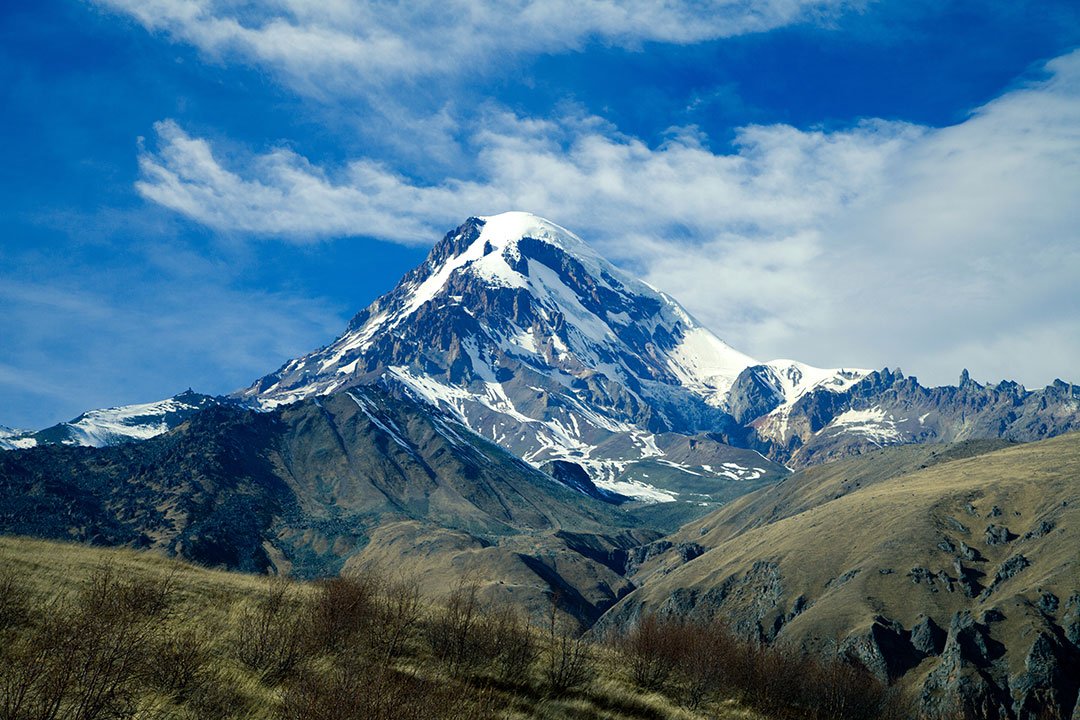
Mount Kazbek is one of the most famous and beautiful mountains in the Caucasus region. Located in northern Georgia, near the border between Georgia and Russia, this magnificent mountain is known for its impressive height, snow-covered summit, glaciers, dramatic landscapes, and fascinating legends. Rising approximately 5,054 meters (16,581 feet) above sea level, Mount Kazbek is among the highest peaks in the Caucasus Mountains and one of Georgia’s most recognizable natural landmarks.
Known locally as Mkinvartsveri, which means “Glacier Peak” or “Ice-Covered Mountain,” Mount Kazbek attracts mountain climbers, hikers, photographers, researchers, and nature enthusiasts from different parts of the world. Its spectacular appearance and challenging climbing routes make it an important destination for adventure tourism in Georgia.
The mountain is also famous for its cultural and historical importance. Local legends connect Mount Kazbek with ancient mythology, while religious traditions associate the surrounding region with important stories from Georgian history. The famous Gergeti Trinity Church, standing on a hillside beneath the mountain, creates one of the most recognizable mountain landscapes in the country.
Mount Kazbek is not simply a geographical feature. It represents the natural beauty, cultural heritage, and adventurous spirit of the Caucasus region. From its volcanic origins and enormous glaciers to its alpine ecosystems and traditional mountain communities, there are many fascinating aspects to explore.
This comprehensive guide explains Mount Kazbek’s location, height, geological history, climate, wildlife, glaciers, tourism, hiking opportunities, climbing history, cultural importance, and environmental challenges.
1. Where Is Mount Kazbek Located?
Mount Kazbek is located in the Greater Caucasus mountain range in northern Georgia. It stands close to the Georgian-Russian border and dominates the landscape of the Kazbegi region.
The mountain belongs to the eastern section of the Greater Caucasus, a large mountain system extending between the Black Sea and the Caspian Sea. The Caucasus Mountains form an important geographical boundary between Eastern Europe and Western Asia.
Mount Kazbek is situated near Stepantsminda, a small mountain town in the Mtskheta-Mtianeti region of Georgia. Stepantsminda serves as the main gateway for visitors exploring the mountain.
The surrounding area contains steep valleys, mountain rivers, alpine meadows, glaciers, and traditional settlements. These natural features create a spectacular environment for outdoor tourism.
The Georgian Military Highway, one of the country’s most important mountain roads, passes through the region and provides access to Stepantsminda.
Visitors traveling from Tbilisi, Georgia’s capital, commonly use this highway to reach the Kazbegi region.
The location of Mount Kazbek makes it particularly attractive because travelers can experience dramatic mountain scenery without traveling deep into an isolated wilderness.
2. How Tall Is Mount Kazbek?
Mount Kazbek has an elevation of approximately 5,054 meters (16,581 feet) above sea level.
This impressive height makes it one of the highest mountains in Georgia and a prominent summit in the Greater Caucasus.
Its elevation places it within the high-altitude mountain environment, where temperatures are considerably colder than in surrounding valleys.
The upper mountain remains covered with snow and ice throughout much of the year. Glaciers occupy several sections of its slopes and contribute to the mountain’s distinctive appearance.
Although Mount Kazbek is not the highest peak in the Caucasus, it is among the region’s most recognizable mountains.
Its impressive volcanic structure and isolated summit create a dramatic profile that can be seen from numerous locations around Stepantsminda.
The mountain’s elevation also makes climbing physically demanding. High-altitude conditions can affect breathing, energy levels, and the body’s ability to adjust to physical activity.
For this reason, climbing Mount Kazbek requires careful preparation, suitable equipment, and attention to mountain weather.
3. The Geological Formation of Mount Kazbek
Mount Kazbek has a fascinating geological history connected to volcanic activity and the formation of the Caucasus Mountains.
The Greater Caucasus developed through complex tectonic processes involving the movement and collision of large sections of Earth’s crust.
Over millions of years, these geological forces gradually created the enormous mountain system that separates the northern and southern Caucasus.
Mount Kazbek is a dormant stratovolcano. A stratovolcano is a large volcanic mountain formed through repeated layers of volcanic material, including lava, ash, and other deposits.
Its volcanic structure reflects a long geological history involving eruptions and changes in the surrounding landscape.
Although Mount Kazbek is not known for frequent modern eruptions, its volcanic origin remains an important part of its scientific significance.
Geologists study the mountain to understand the relationship between volcanic activity, tectonic movement, and mountain formation.
The surrounding rocks provide valuable evidence about the geological development of the Caucasus.
Glacial erosion has also played an important role in shaping the mountain. Over long periods, moving ice has carved valleys, modified slopes, and transported large quantities of rock material.
These processes continue to influence the mountain’s landscape.
4. Why Is Mount Kazbek Famous?
Mount Kazbek is famous for several reasons, including its impressive height, natural beauty, cultural significance, and challenging climbing routes.
One of its most recognizable features is its enormous snow-covered summit.
The mountain often appears above the clouds, creating a spectacular scene that attracts photographers and travelers.
Another reason for its popularity is the Gergeti Trinity Church, which stands on a mountain ridge overlooking the surrounding valleys.
The combination of the historic church and Mount Kazbek creates one of the most photographed landscapes in Georgia.
Mount Kazbek is also well known among international climbers because it offers an opportunity to experience high-altitude mountaineering in the Caucasus.
Its climbing routes attract people with different levels of mountain experience, although reaching the summit requires appropriate technical skills and preparation.
The mountain is also associated with ancient mythology and Georgian folklore.
These cultural connections make it interesting not only to adventure travelers but also to historians and people interested in traditional stories.
5. The Climate of Mount Kazbek
The climate around Mount Kazbek changes significantly with altitude.
The lower valleys experience a mountain climate with relatively mild summers and cold winters.
As elevation increases, temperatures decrease and weather conditions become more severe.
The upper mountain experiences an alpine environment characterized by snow, ice, strong winds, and rapidly changing weather.
Summer is generally the most popular season for climbing and mountain tourism.
Even during summer, temperatures near the summit can remain below freezing.
Winter brings heavy snowfall, extremely low temperatures, and challenging weather conditions.
Clouds can develop quickly around the summit, reducing visibility and making mountain travel more difficult.
Strong winds are another important feature of the mountain climate.
These winds can increase the effects of cold temperatures and create difficult conditions for climbers.
Visitors should understand that mountain weather can change unexpectedly. A pleasant morning in the valley does not guarantee favorable conditions higher on the mountain.
Professional weather information and local mountain guidance are important when planning outdoor activities.
6. Glaciers of Mount Kazbek
Glaciers are among the most important natural features of Mount Kazbek.
A glacier is a large mass of ice that forms when accumulated snow gradually becomes compressed and transforms into dense ice.
Mount Kazbek contains several glacial areas that contribute to its impressive appearance.
The Gergeti Glacier is one of the best-known glaciers associated with the mountain.
It occupies part of the upper slopes and is an important feature of the surrounding alpine environment.
Other glacial formations and ice-covered areas also exist around the mountain.
These glaciers influence the regional water system by releasing meltwater into streams and rivers.
Glacial meltwater contributes to the flow of mountain waterways and supports ecosystems in the surrounding valleys.
Glaciers are also important indicators of climate change.
Changes in temperature and snowfall influence their size, movement, and long-term stability.
Like many glaciers around the world, those in the Caucasus have experienced changes associated with rising temperatures.
Scientists monitor these changes to understand the effects of global climate patterns on mountain environments.
The glaciers of Mount Kazbek are therefore valuable not only for their natural beauty but also for scientific research.
7. Gergeti Trinity Church and Mount Kazbek
One of the most famous landmarks near Mount Kazbek is Gergeti Trinity Church.
The church is located above Stepantsminda at an elevation of approximately 2,170 meters.
It stands on a scenic hillside overlooking the surrounding valleys and the enormous mountain.
Built during the 14th century, Gergeti Trinity Church is an important example of traditional Georgian religious architecture.
Its stone construction and relatively simple design reflect the architectural traditions of the region.
The church has great cultural and religious importance for Georgia.
For centuries, it served as a place of worship and became an important symbol of the local community.
Its remote mountain location also contributed to its historical significance.
The church is especially popular among photographers because Mount Kazbek creates a dramatic background.
Visitors frequently travel from Stepantsminda to see the church and enjoy the surrounding mountain scenery.
The area is one of Georgia’s most recognizable tourism destinations.
8. Wildlife Around Mount Kazbek
The mountain environment around Mount Kazbek supports a variety of wildlife species.
Different animals inhabit the lower forests, alpine meadows, rocky slopes, and remote mountain valleys.
The surrounding Caucasus region is particularly important for biodiversity.
Mountain mammals include species adapted to cold weather and difficult terrain.
Depending on the location and habitat, wildlife in the wider region includes:
- Caucasian tur.
- Chamois.
- Red fox.
- Brown bear.
- Wolf.
- Lynx.
- Various small mammals.
The Caucasian tur is particularly associated with the Greater Caucasus.
It is a wild mountain goat adapted to steep rocky environments.
Its specialized climbing abilities help it move across difficult mountain terrain.
Birdlife is also an important part of the ecosystem.
The region supports different mountain birds, including raptors and species associated with alpine habitats.
Birdwatchers may encounter eagles, vultures, and other birds depending on the season and location.
Wildlife observation requires patience and respect for natural habitats.
Visitors should avoid disturbing animals or approaching them unnecessarily.
Protecting the natural environment helps preserve the mountain’s biodiversity.
9. Plant Life and Alpine Vegetation
Vegetation around Mount Kazbek changes according to altitude, temperature, and soil conditions.
The lower slopes support grasses, shrubs, and different mountain plants.
As elevation increases, forests become less common and are gradually replaced by alpine meadows and specialized vegetation.
Alpine plants are adapted to cold temperatures, strong winds, and short growing seasons.
Many species grow close to the ground to reduce exposure to harsh environmental conditions.
During summer, alpine meadows can become colorful with wildflowers.
These plants provide important resources for insects and contribute to the mountain ecosystem.
Above the vegetation zone, rocky surfaces, snowfields, and glaciers dominate the landscape.
The transition between different vegetation zones makes Mount Kazbek an interesting destination for botanists and nature enthusiasts.
10. Mount Kazbek and Ancient Mythology
Mount Kazbek is connected with fascinating stories from ancient mythology.
One famous tradition associates the mountain with Prometheus, a figure from Greek mythology.
According to the myth, Prometheus was punished by Zeus for giving fire to humanity.
He was chained to a mountain, where an eagle repeatedly attacked him as part of his punishment.
Different Caucasus traditions connect this story with Mount Kazbek or nearby mountain landscapes.
The exact relationship between the mythology and the mountain varies across historical interpretations and local storytelling traditions.
These legends demonstrate how mountains have influenced human imagination throughout history.
Their enormous height, dramatic appearance, and mysterious weather conditions have inspired stories about gods, heroes, and supernatural events.
Mount Kazbek remains an important part of the cultural imagination of the Caucasus.
11. The History of Mount Kazbek Exploration
Mount Kazbek has attracted explorers, scientists, and climbers for many generations.
The Caucasus region became increasingly important to European geographical exploration during the 18th and 19th centuries.
Travelers documented the region’s landscapes, settlements, mountain routes, and natural resources.
Mount Kazbek became particularly interesting because of its height and volcanic structure.
The first recorded successful ascent of Mount Kazbek is generally associated with the British mountaineer Douglas Freshfield and his companions in 1868.
Their expedition represented an important milestone in the history of Caucasus mountaineering.
The ascent helped introduce Mount Kazbek to the international climbing community.
Since then, the mountain has become an established destination for mountaineering and scientific research.
Modern climbers continue to visit the region to experience its glaciers, volcanic landscapes, and challenging alpine environment.
12. Mount Kazbek as a Climbing Destination
Mount Kazbek is one of the most popular high-altitude climbing destinations in Georgia.
Its combination of impressive elevation, glacier landscapes, and relatively accessible starting points makes it attractive to experienced mountaineers.
However, the mountain should never be considered an easy hiking destination.
Climbing above the glacier zone involves serious mountain hazards.
These can include crevasses, sudden weather changes, snow conditions, altitude-related problems, and difficult visibility.
Climbers generally spend time acclimatizing before attempting the summit.
Acclimatization allows the body to gradually adjust to reduced oxygen availability at higher elevations.
The climbing season is generally concentrated in summer, although conditions vary from year to year.
A typical climbing expedition may involve several days in the region, including preparation, acclimatization, and time at higher mountain camps.
Climbers should use qualified local guides when appropriate and follow current safety recommendations.
Suitable equipment and previous high-altitude experience are essential considerations.
13. Hiking Around Mount Kazbek
Not everyone visiting Mount Kazbek needs to attempt its summit.
The surrounding region contains numerous beautiful hiking opportunities.
One of the most popular activities is hiking from Stepantsminda toward Gergeti Trinity Church.
This route provides spectacular views of the surrounding valleys and Mount Kazbek.
The hike is especially popular during the warmer months.
Visitors can also explore mountain trails around nearby villages and valleys.
These routes offer opportunities to experience traditional Georgian settlements, alpine landscapes, and local culture.
Some trails are relatively accessible, while others require greater fitness and navigation skills.
Weather conditions should always be considered before starting a mountain walk.
Hikers should carry appropriate clothing, drinking water, and navigation equipment.
Respecting local land-use practices and natural habitats is also important.
14. Stepantsminda: The Gateway to Mount Kazbek
Stepantsminda is the main settlement associated with Mount Kazbek.
It is located in the northern part of Georgia and serves as the principal tourism center for the surrounding mountain region.
The town was historically known as Kazbegi.
Its present name, Stepantsminda, is connected with local religious and historical traditions.
The settlement offers accommodation, restaurants, guesthouses, transportation services, and mountain tourism facilities.
Many visitors use Stepantsminda as their base for exploring the region.
The town also provides excellent views of Mount Kazbek.
Its location in a broad mountain valley makes it an attractive destination even for travelers who do not plan to hike or climb.
Visitors can experience Georgian hospitality, traditional food, and local culture.
Stepantsminda plays an important role in supporting tourism and the regional economy.
15. The Georgian Military Highway
The Georgian Military Highway is one of the most famous mountain roads in the Caucasus.
It connects Tbilisi with the northern Caucasus region and provides access to Stepantsminda.
The road passes through spectacular mountain scenery, including valleys, rivers, and high mountain passes.
Historically, it has served as an important transportation route between Georgia and Russia.
The road has played a major role in regional trade, travel, and military movements.
Today, it is also an important tourism route.
Travelers often enjoy stopping at scenic viewpoints along the highway.
The journey provides opportunities to experience the dramatic landscapes of the Greater Caucasus.
Weather and road conditions can change, especially during winter.
Travelers should check current transportation information before beginning the journey.
16. Best Time to Visit Mount Kazbek
The best time to visit Mount Kazbek depends on the activities a traveler wants to enjoy.
Summer is generally the most popular season for hiking, sightseeing, and climbing.
June, July, August, and early September often provide the most favorable conditions for mountain tourism.
During summer, the lower valleys become greener and alpine flowers appear in many areas.
The weather can still be unpredictable at high elevations.
Spring brings changing conditions as winter snow begins to melt.
Some hiking routes may remain difficult because of snow and wet ground.
Autumn offers beautiful mountain scenery, cooler temperatures, and changing vegetation.
Winter creates a completely different landscape.
The region becomes snow-covered and temperatures can become extremely cold.
Winter tourism requires additional preparation and awareness of mountain conditions.
For general sightseeing, summer and early autumn are popular choices.
For climbing, the best period depends on current snow, ice, and weather conditions rather than calendar dates alone.
17. Tourism and the Local Economy
Tourism plays an important role in the economy of the Kazbegi region.
Mount Kazbek attracts domestic and international visitors throughout the year.
Tourism creates opportunities for guesthouses, hotels, restaurants, transportation companies, guides, and local businesses.
Many families benefit from providing accommodation and traditional hospitality services.
Local guides contribute valuable knowledge about mountain routes, weather, regional history, and cultural traditions.
Tourism also encourages investment in infrastructure.
Road improvements, accommodation facilities, and visitor services help make the region more accessible.
However, tourism growth must be managed carefully.
Too many visitors can place pressure on local resources and natural habitats.
Sustainable tourism practices can help balance economic development with environmental protection.
18. Traditional Culture Around Mount Kazbek
The communities around Mount Kazbek have a rich cultural heritage.
Mountain life has traditionally been influenced by geography, weather, agriculture, livestock, and local traditions.
The region is associated with Georgian language, music, religious architecture, traditional clothing, and hospitality.
Local communities have developed ways of living that reflect the challenges of mountain environments.
Traditional food is an important part of regional culture.
Georgian cuisine is known for dishes such as khinkali, khachapuri, and various meat and vegetable preparations.
Visitors to Stepantsminda can experience local hospitality through family-run guesthouses and restaurants.
Traditional celebrations and religious customs remain important in many communities.
The cultural heritage of the region adds another dimension to the Mount Kazbek experience.
19. Photography Opportunities at Mount Kazbek
Mount Kazbek is an outstanding destination for landscape photography.
Its enormous summit, glaciers, valleys, and historic landmarks create many opportunities for memorable photographs.
Gergeti Trinity Church is one of the most recognizable photography locations.
The church and mountain create a striking combination of architecture and natural scenery.
Early morning and late afternoon often provide attractive natural lighting.
Clouds moving around the summit can also create dramatic photographic conditions.
The surrounding valleys offer different perspectives of the mountain.
Photographers interested in wildlife and alpine plants may also find interesting subjects in the region.
Weather can change rapidly, so photography plans should remain flexible.
Protecting equipment from cold, moisture, and wind is important at higher elevations.
20. Water Resources and Rivers
Mount Kazbek plays an important role in the regional water system.
Snow and ice accumulated on the mountain contribute to meltwater that enters surrounding streams and rivers.
The Terek River is one of the most important waterways associated with the wider region.
It flows northward through the Caucasus and eventually enters Russian territory.
Mountain water resources support ecosystems, agriculture, and communities.
Glacial and seasonal snowmelt influence the timing and volume of water flowing through mountain valleys.
Changes in glacier size and snow accumulation may influence future water availability.
For this reason, the mountain environment is important to regional hydrological research.
21. Scientific Research on Mount Kazbek
Mount Kazbek offers opportunities for scientific research in several fields.
Geologists study its volcanic structure and the geological development of the Caucasus.
Glaciologists examine glaciers, ice movement, and changing snow conditions.
Climatologists investigate temperature patterns, precipitation, and long-term climate trends.
Ecologists study alpine plants, wildlife, and environmental relationships.
Researchers are also interested in how mountain communities respond to environmental changes.
High-altitude environments provide important information about climate systems because they can respond strongly to changes in temperature and precipitation.
Scientific research helps improve understanding of mountain ecosystems and their future development.
22. Environmental Challenges Facing Mount Kazbek
Like many mountain environments, Mount Kazbek faces several environmental challenges.
Climate change is one of the most important concerns.
Increasing temperatures can affect glaciers, snow accumulation, vegetation, and wildlife habitats.
Glacier retreat may change the timing and amount of water entering nearby rivers.
Mountain ecosystems are also vulnerable to human activities.
Tourism can produce waste, disturb wildlife, and damage sensitive vegetation if visitor numbers are not managed responsibly.
Road development and construction may also influence natural habitats.
Natural hazards such as landslides, rockfalls, and avalanches are additional concerns in mountainous areas.
Environmental monitoring and responsible tourism can help reduce some of these pressures.
Protecting Mount Kazbek requires cooperation between local communities, scientists, government organizations, and visitors.
23. Sustainable Tourism at Mount Kazbek
Sustainable tourism means visiting natural destinations while minimizing environmental damage and supporting local communities.
Mount Kazbek offers many opportunities for responsible travel.
Visitors can support locally owned guesthouses, restaurants, and guiding services.
Using reusable water bottles and carrying away personal waste can reduce pollution.
Staying on established paths helps protect sensitive alpine vegetation.
Respecting wildlife is also essential.
Visitors should avoid disturbing animals or damaging their habitats.
Local cultural traditions and religious sites should be treated respectfully.
Sustainable tourism can provide long-term economic benefits while helping preserve the mountain’s natural and cultural heritage.
24. Interesting Facts About Mount Kazbek
Mount Kazbek has many fascinating characteristics.
- Mount Kazbek is approximately 5,054 meters high.
- It is located in the Greater Caucasus mountain range.
- It is one of Georgia’s most famous mountains.
- Its local Georgian name is Mkinvartsveri.
- It is a dormant stratovolcano.
- It is located near the town of Stepantsminda.
- Gergeti Trinity Church is one of its most famous nearby landmarks.
- The mountain contains glaciers, including the Gergeti Glacier.
- Its first recorded successful ascent took place in 1868.
- The mountain is associated with ancient Prometheus legends.
- It attracts international climbers and hikers.
- Its upper slopes experience severe alpine weather.
- The mountain is an important subject for geological research.
- The surrounding region supports a variety of wildlife.
- Mount Kazbek is one of the most photographed natural landmarks in Georgia.
These facts demonstrate why the mountain is important from geographical, cultural, historical, and environmental perspectives.
25. How to Reach Mount Kazbek
Most international visitors reach Mount Kazbek through Georgia’s capital, Tbilisi.
Tbilisi has an international airport with connections to several countries.
From the capital, travelers can continue toward Stepantsminda using the Georgian Military Highway.
The journey offers beautiful views of the Caucasus Mountains.
Visitors can travel using private vehicles, organized tours, or available local transportation services.
Stepantsminda is the main base for exploring the surrounding mountain region.
From there, travelers can visit Gergeti Trinity Church, explore nearby valleys, or arrange guided mountain activities.
Anyone planning a climbing expedition should organize the necessary guides, accommodation, equipment, and safety arrangements in advance.
Travelers should also check current road conditions and local travel information.
26. Accommodation Near Mount Kazbek
Stepantsminda offers several types of accommodation.
Visitors can choose from guesthouses, small hotels, family-run properties, and larger accommodation facilities.
Guesthouses are particularly popular because they provide opportunities to experience Georgian hospitality.
Many properties offer mountain views and access to local restaurants.
Accommodation prices vary according to season, facilities, location, and demand.
Summer is a busy tourism period, so booking ahead can be helpful.
Travelers visiting during colder months should check heating arrangements and transportation availability.
Staying in Stepantsminda makes it easier to explore Mount Kazbek and surrounding attractions.
27. Food and Local Cuisine
Food is an important part of the travel experience around Mount Kazbek.
Georgia is famous for its traditional cuisine, which combines fresh ingredients, regional recipes, and distinctive flavors.
Khinkali is one of the country’s best-known dishes.
These dumplings are traditionally filled with meat or other ingredients and are widely enjoyed throughout Georgia.
Khachapuri is another famous Georgian food.
It consists of bread filled with cheese, with different regional variations.
Other popular foods include grilled meats, vegetable dishes, bean preparations, and traditional soups.
Visitors can find Georgian cuisine in restaurants and family-run guesthouses around Stepantsminda.
Trying local food offers an opportunity to experience the region’s cultural identity.
28. Safety Considerations for Visitors
Mount Kazbek is a beautiful destination, but its mountain environment requires careful preparation.
Weather conditions can change quickly.
Cold temperatures, strong winds, snow, and reduced visibility can create challenging conditions.
Visitors exploring lower hiking routes should wear suitable footwear and carry appropriate clothing.
People planning high-altitude climbing need more extensive preparation.
Glacier travel can involve crevasses and other hazards that require specialist knowledge and equipment.
Altitude sickness is another important concern.
Symptoms can develop when people ascend too quickly to high elevations.
Gradual acclimatization and appropriate professional guidance are important for high-altitude activities.
Visitors should avoid taking unnecessary risks or attempting routes beyond their experience.
Local guides and current mountain information can help travelers make informed decisions.
29. Mount Kazbek Compared With Other Caucasus Mountains
The Greater Caucasus contains many impressive peaks.
Mount Elbrus, located in Russia, is the highest mountain in the Caucasus, with an elevation of approximately 5,642 meters.
Mount Shkhara, located on the Georgia-Russia border, is Georgia’s highest mountain, reaching approximately 5,193 meters.
Mount Kazbek, at approximately 5,054 meters, is another major summit in this mountain system.
Although it is lower than these peaks, Mount Kazbek remains one of the most recognizable mountains in the region.
Its popularity is connected to its scenery, accessibility, volcanic history, cultural associations, and climbing opportunities.
The combination of natural and historical attractions gives Mount Kazbek a distinctive identity.
30. The Importance of Mount Kazbek for Georgia
Mount Kazbek is an important symbol of Georgia’s natural heritage.
Its dramatic appearance represents the country’s mountainous northern landscape.
The mountain contributes to regional tourism and attracts visitors from around the world.
It also supports scientific research and provides valuable information about glaciers, climate, geology, and alpine ecosystems.
The surrounding communities benefit from tourism and related economic activities.
Culturally, Mount Kazbek is connected with Georgian traditions, religious heritage, and regional folklore.
Its presence in photographs, travel publications, and cultural stories has helped establish it as one of Georgia’s most recognizable natural landmarks.
Protecting this mountain is important for future generations.
31. Why Travelers Should Visit Mount Kazbek
Mount Kazbek offers a memorable experience for people interested in nature, culture, and adventure.
Its snow-covered summit creates an impressive landscape.
The nearby Gergeti Trinity Church provides an opportunity to explore Georgian religious architecture.
Stepantsminda offers traditional hospitality and access to mountain tourism facilities.
Visitors can enjoy photography, hiking, sightseeing, and cultural exploration.
Experienced mountaineers may also consider a guided climbing expedition.
The surrounding region offers a combination of natural beauty and historical importance that is difficult to find in many other destinations.
Even travelers who prefer relaxed sightseeing can appreciate the mountain from nearby viewpoints.
32. The Future of Mount Kazbek Tourism
Tourism around Mount Kazbek is likely to remain important for Georgia.
As international interest in mountain destinations continues, the Kazbegi region has opportunities to develop its tourism services.
Improved accommodation, transportation, guiding services, and visitor facilities may support future growth.
However, development should be planned carefully.
Uncontrolled tourism can create environmental pressure and affect local communities.
Responsible tourism policies can help protect sensitive habitats and preserve cultural traditions.
Climate change will also influence the future of mountain tourism.
Changes in snow and glacier conditions may affect climbing routes and seasonal activities.
Scientific monitoring and local environmental planning will be increasingly important.
A sustainable approach can help ensure that Mount Kazbek remains an attractive and protected destination.
Conclusion
Mount Kazbek is one of the most remarkable mountains in the Greater Caucasus and an important natural landmark of Georgia.
Rising approximately 5,054 meters above sea level, it is famous for its snow-covered summit, glaciers, volcanic origins, dramatic valleys, and impressive alpine environment.
The mountain’s importance extends far beyond its elevation.
Its connection with Georgian history, religious architecture, ancient mythology, and traditional mountain communities makes it a fascinating destination for travelers and researchers.
The nearby town of Stepantsminda provides access to the mountain, while Gergeti Trinity Church creates one of the most recognizable views in the entire Caucasus region.
Mount Kazbek also plays an important environmental role through its glaciers, water resources, wildlife habitats, and alpine ecosystems.
For climbers, it represents an exciting high-altitude challenge. For hikers and photographers, it offers beautiful landscapes and memorable experiences. For cultural travelers, it provides opportunities to discover Georgian traditions and history.
However, preserving this remarkable mountain requires responsible tourism and environmental protection.
By respecting local communities, protecting natural habitats, and following mountain safety practices, visitors can help preserve Mount Kazbek for future generations.
Whether someone is interested in geography, geology, adventure travel, photography, wildlife, or cultural history, Mount Kazbek remains one of the most fascinating mountains to explore in Georgia.
Frequently Asked Questions (FAQs)
1. Where is Mount Kazbek located?
Mount Kazbek is located in the Greater Caucasus mountain range in northern Georgia, close to the Russian border.
2. How high is Mount Kazbek?
Mount Kazbek has an elevation of approximately 5,054 meters (16,581 feet) above sea level.
3. What is Mount Kazbek famous for?
It is famous for its snow-covered summit, glaciers, volcanic origins, mountain climbing opportunities, and nearby Gergeti Trinity Church.
4. Is Mount Kazbek a volcano?
Yes. Mount Kazbek is a dormant stratovolcano with a geological history connected to volcanic activity.
5. What is the local name of Mount Kazbek?
Its Georgian name is Mkinvartsveri, commonly translated as Glacier Peak.
6. Can tourists visit Mount Kazbek?
Yes. Tourists can visit the surrounding region, explore Stepantsminda, hike to Gergeti Trinity Church, and enjoy mountain viewpoints.
7. Is Mount Kazbek suitable for beginner climbers?
Summit climbing is not generally suitable for inexperienced beginners without proper preparation and qualified professional support. The mountain involves high-altitude and glacier-related hazards.
8. What is the best time to visit Mount Kazbek?
Summer and early autumn are generally popular periods for sightseeing and hiking. Climbing conditions depend on current mountain weather and snow conditions.
9. What is the nearest town to Mount Kazbek?
Stepantsminda is the main nearby town and the principal starting point for visitors exploring the mountain.
10. What is Gergeti Trinity Church?
It is a historic Georgian Orthodox church located above Stepantsminda, overlooking Mount Kazbek and the surrounding valleys.
11. Are there glaciers on Mount Kazbek?
Yes. The mountain contains several glacial areas, including the well-known Gergeti Glacier.
12. Who first climbed Mount Kazbek?
The first recorded successful ascent is generally credited to British mountaineer Douglas Freshfield and his companions in 1868.
13. What animals live around Mount Kazbek?
The wider region supports wildlife such as Caucasian tur, chamois, foxes, wolves, brown bears, and different mountain birds.
14. Why is Mount Kazbek important to Georgia?
It is important for its natural beauty, tourism, cultural heritage, scientific value, and connection with Georgian history.
15. Is Mount Kazbek worth visiting?
Yes. It offers spectacular mountain scenery, historic landmarks, hiking opportunities, traditional Georgian culture, and memorable travel experiences.
SEO Information
SEO Title: Mount Kazbek: Complete Travel, Climbing and Mountain Guide
Meta Description: Discover Mount Kazbek in Georgia, including its height, location, glaciers, history, hiking routes, climbing opportunities, wildlife, and travel tips.
Focus Keyword: Mount Kazbek
Secondary Keywords:
- Mount Kazbek Georgia
- Kazbek Mountain
- Mount Kazbek height
- Mount Kazbek location
- Mount Kazbek climbing
- Mount Kazbek hiking
- Caucasus Mountains Georgia
- Gergeti Trinity Church
- Stepantsminda Georgia
- Mount Kazbek glaciers
Suggested URL Slug: mount-kazbek-georgia
Suggested Category: Mountains / Travel / Geography
Article Tags: Mount Kazbek, Georgia Mountains, Caucasus Mountains, Mountain Climbing, Mountain Hiking, Georgian Travel, Alpine Landscapes, Gergeti Trinity Church