
Introduction
Mount Erebus is one of the most extraordinary natural landmarks on Earth. Located in Antarctica, this remarkable mountain is famous for its active volcanic activity, extreme environment, icy slopes, and unusual permanent lava lake. It is considered the southernmost historically active volcano in the world and is one of the most scientifically interesting volcanoes on the planet.
Rising approximately 3,794 meters (12,448 feet) above sea level, Mount Erebus dominates the landscape of Ross Island in the Ross Sea. Unlike many other famous mountains, which are known mainly for their height or climbing opportunities, Mount Erebus attracts international attention because of its continuous volcanic activity in one of the coldest regions on Earth.
One of its most unusual features is its persistent lava lake, which has been observed since at least 1972. This remarkable geological feature allows scientists to study molten rock, volcanic gases, and the processes occurring deep beneath Earth’s surface.
Mount Erebus is also important because it provides valuable information about Antarctica’s geological history. Its volcanic structure, unusual lava composition, and relationship with the surrounding environment help researchers understand how volcanoes develop in continental rift regions.
In this comprehensive guide, we will explore Mount Erebus, including its location, geographical features, geological history, volcanic activity, climate, wildlife, scientific importance, exploration history, and interesting facts.
1. Where Is Mount Erebus Located?
Mount Erebus is located on Ross Island in Antarctica, near the southern end of the Ross Sea. Ross Island is one of the most recognizable volcanic islands in the Antarctic region.
The mountain stands in an isolated environment surrounded by glaciers, snow-covered landscapes, frozen water, and enormous ice formations. Its location makes it one of the most remote active volcanoes in the world.
Mount Erebus is positioned at approximately 77.53 degrees south latitude and 167.17 degrees east longitude. It overlooks the McMurdo research region and is relatively close to important Antarctic scientific facilities.
Ross Island contains several major volcanic mountains, including Mount Erebus and Mount Terror. Mount Erebus is the largest of these major volcanoes.
Its geographical location is especially interesting because volcanic heat exists alongside extremely low environmental temperatures. While much of Antarctica remains covered by thick ice, Mount Erebus maintains an active volcanic system beneath its snowy exterior.
The surrounding region is important for international scientific research. Researchers study its geological formations, atmospheric conditions, ice movements, and volcanic processes.
2. Height and Physical Characteristics of Mount Erebus
Mount Erebus reaches an elevation of approximately 3,794 meters above sea level.
Although it is not among the tallest mountains in the world, its location and geological characteristics make it exceptionally important.
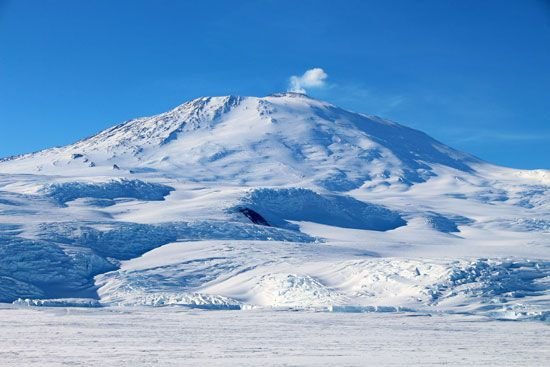
The mountain has a large volcanic structure with steep upper slopes, a summit crater, and extensive areas covered by snow and ice.
Its summit contains a main crater approximately 500 by 600 meters wide and around 110 meters deep. Within this crater is a smaller inner crater that contains the famous lava lake.
The mountain’s shape reflects millions of years of volcanic development. Different periods of volcanic activity have created layers of volcanic material, including solidified lava and other volcanic deposits.
Mount Erebus is classified as a stratovolcano, also known as a composite volcano. This type of volcano develops through repeated volcanic activity that builds up layers of material over time.
The mountain’s appearance changes depending on weather conditions, sunlight, cloud cover, and seasonal variations.
Its snowy slopes and dark volcanic formations create a remarkable contrast that makes it one of Antarctica’s most recognizable geological features.
3. Why Is Mount Erebus Famous?
Mount Erebus is famous for several reasons.
First, it is recognized as the southernmost historically active volcano in the world.
Second, it contains one of the world’s best-known persistent lava lakes. This unusual feature provides scientists with an opportunity to study molten lava over extended periods.
Third, it is located in Antarctica, a continent generally associated with ice, freezing temperatures, and glaciers rather than active volcanic systems.
The combination of extreme cold and volcanic heat makes Mount Erebus especially fascinating.
The mountain is also famous for its scientific research programs. Scientists from different countries have studied its volcanic gases, seismic activity, lava composition, and internal structure.
Its geological importance extends beyond Antarctica because the processes occurring beneath the mountain help researchers understand volcanic systems in other parts of the world.
Mount Erebus is also associated with an important historical event involving Antarctic exploration and the discovery of the Ross Island region.
4. Discovery of Mount Erebus
Mount Erebus was discovered by British explorer and naval officer Sir James Clark Ross during an Antarctic expedition in January 1841.
Ross led an expedition that explored large areas of the southern ocean and surrounding Antarctic coastline.
During the journey, his expedition encountered Ross Island and observed the impressive volcanic mountains rising above the icy landscape.
Mount Erebus was named after HMS Erebus, one of the two ships used during the expedition. The other ship was HMS Terror.
The name Erebus comes from Greek mythology, where Erebus represents darkness.
When Ross first observed the mountain, he noticed volcanic activity around its summit. Smoke and volcanic emissions could be seen rising above the mountain.
The discovery was significant because it provided important evidence of volcanic activity in Antarctica.
Ross’s expedition also contributed to the geographical understanding of the Ross Sea, Victoria Land, and nearby Antarctic regions.
The discovery of Mount Erebus became an important chapter in the history of polar exploration.
5. Geological Formation of Mount Erebus
Mount Erebus developed through repeated volcanic activity over a very long geological period.
Its formation is connected to the geological processes occurring beneath the Antarctic continent.
The mountain belongs to the McMurdo Volcanic Province, a region containing several volcanic formations.
Its volcanic activity is associated with a continental rift environment. A continental rift develops when sections of Earth’s crust gradually stretch and move apart.
These geological processes can create pathways through which molten material rises from deeper parts of Earth.
Mount Erebus is particularly interesting because its magma has a chemical composition that differs from the magma found in many other well-known volcanoes.
Its dominant volcanic rock type is phonolite.
Phonolite is an unusual volcanic rock that is relatively rich in alkali elements, particularly sodium and potassium.
Repeated volcanic eruptions and the accumulation of volcanic materials gradually created the mountain’s large structure.
Different stages of geological development produced summit depressions known as calderas.
A caldera is a large volcanic depression that develops when part of a volcano’s summit collapses or changes following major volcanic activity.
The modern summit cone developed within an older volcanic structure.
Today, Mount Erebus represents an important example of long-term volcanic development in an Antarctic continental rift setting.
6. Mount Erebus and Its Famous Lava Lake
One of the most remarkable features of Mount Erebus is its persistent lava lake.
A lava lake is a relatively large accumulation of molten rock located within a volcanic crater or depression.
Unlike lava flows that move down a volcano’s slopes, a lava lake remains concentrated within a particular area.
Mount Erebus has a well-known lava lake inside its summit crater. Continuous lava-lake activity has been documented since at least 1972.
The lake provides a rare opportunity for scientists to observe volcanic processes over an extended period.
Its surface can change as molten material moves, gases escape, and volcanic conditions develop.
The lava lake is particularly interesting because it exists in an environment where surrounding temperatures are extremely low.
Scientists use specialized equipment and observations to study its temperature, chemical composition, movement, and associated gas emissions.
The lava lake also helps researchers understand the relationship between magma movement beneath a volcano and activity visible at the surface.
Its continued activity makes Mount Erebus an important natural laboratory for volcanology.
7. Volcanic Activity of Mount Erebus
Mount Erebus is an active volcano.
Its activity includes persistent lava-lake behavior, volcanic gas emissions, seismic activity, and occasional explosive events.
Many of its eruptions are relatively small compared with major explosive volcanic eruptions elsewhere in the world.
Some activity is described as Strombolian, a type of volcanic activity involving intermittent explosions that release gas and volcanic material.
These events can produce volcanic fragments that are deposited around the summit crater.
Scientists continuously study the mountain because volcanic activity can change over time.
Seismic instruments help researchers detect movements beneath the volcano, while satellite observations provide information about surface temperatures and thermal activity.
Gas measurements also help scientists understand changes in the volcanic system.
The Smithsonian Institution’s Global Volcanism Program records Mount Erebus as an active volcano and maintains information about its eruptive history.
Understanding its activity is important because volcanic systems can change even when their visible behavior appears relatively stable.
8. Why Does Mount Erebus Remain Active in Antarctica?
Mount Erebus remains active because of geological processes occurring beneath Earth’s surface.
Although Antarctica is known for its enormous ice sheets, the continent is not geologically inactive.
The Antarctic region contains several volcanic areas, including the McMurdo Volcanic Province.
Mount Erebus is associated with a continental rift environment.
In these regions, the Earth’s crust experiences stretching and geological deformation.
Such conditions can allow molten rock to rise from deeper geological layers toward the surface.
The magma beneath Mount Erebus contains dissolved gases and has a chemical composition that contributes to its distinctive volcanic behavior.
The volcano’s persistent lava lake demonstrates that molten material continues to reach and remain near the surface.
Scientists study these processes to understand how magma moves through the Earth’s crust.
The mountain is an excellent example of how volcanic activity can continue even in an environment dominated by ice and freezing temperatures.
9. Climate and Weather Conditions
The climate around Mount Erebus is extremely cold and challenging.
Antarctica is the coldest continent on Earth, and the Ross Island region experiences severe weather conditions.
Temperatures can remain below freezing throughout much of the year.
Winter conditions are particularly harsh, with long periods of darkness and powerful winds.
During the Antarctic summer, sunlight remains visible for extended periods, although temperatures generally remain very low.
Strong winds can move snow across exposed surfaces and create difficult visibility conditions.
Weather around Mount Erebus can change quickly.
Clouds, blowing snow, and storms may affect the appearance of the mountain and surrounding landscape.
The combination of cold temperatures, high elevation, wind, and volcanic terrain creates an unusual environmental setting.
Despite these challenges, scientists continue to conduct research in the region using specialized equipment and carefully planned field programs.
10. Snow and Ice Around Mount Erebus
Mount Erebus is surrounded by an extraordinary landscape of snow and ice.
Its upper slopes are covered by glaciers and permanent snowfields.
The surrounding Ross Island region contains several important glacial formations.
One notable feature is the Erebus ice tongue, which extends from the mountain’s glacial system into McMurdo Sound.
An ice tongue is a long extension of glacier ice that projects outward into a body of water.
This formation is an important part of the local Antarctic landscape.
The relationship between volcanic heat and surrounding ice is scientifically interesting.
Researchers investigate how geothermal conditions affect ice formations and how glacial processes influence the surrounding volcanic environment.
Snow accumulation and ice movement also contribute to the changing appearance of the mountain.
The surrounding ice formations make Mount Erebus a unique example of a volcanic mountain developing within an extremely cold polar environment.
11. Wildlife Around Mount Erebus
Although Antarctica has limited terrestrial wildlife, the wider Ross Island region supports several fascinating animal species.
Most of the region’s wildlife is connected to the surrounding ocean, coastal areas, and ice-covered environments.
Adélie penguins are among the well-known birds found in parts of the Ross Sea region.
Emperor penguins also inhabit suitable Antarctic coastal environments.
Other animals associated with the wider region include Weddell seals, leopard seals, and various seabirds.
The surrounding Southern Ocean provides food and habitat for these animals.
Antarctic wildlife has developed remarkable adaptations to survive cold temperatures.
Penguins have specialized feathers and insulating layers that help maintain body warmth.
Seals have thick layers of blubber that provide insulation in freezing water.
However, Mount Erebus itself is not a major wildlife habitat because its upper slopes are too cold, steep, and exposed for most animals.
Wildlife is generally found in more suitable coastal and marine environments.
The protection of Antarctic wildlife is an important part of international environmental conservation efforts.
12. Mount Erebus and Scientific Research
Mount Erebus is one of the most scientifically studied volcanoes in Antarctica.
Its persistent lava lake and unusual geological characteristics provide researchers with valuable opportunities to investigate volcanic processes.
Scientists study several aspects of the mountain, including:
- Magma composition.
- Volcanic gas emissions.
- Lava-lake behavior.
- Seismic activity.
- Internal geological structure.
- Thermal conditions.
- Interaction between volcanic activity and ice.
Research teams use specialized instruments to collect information from the volcano.
Seismometers detect vibrations and earthquakes associated with underground activity.
Thermal instruments measure temperature variations.
Satellite observations help researchers monitor the mountain from space.
Gas sampling provides information about the chemical materials released by the volcano.
These different research methods help create a more complete understanding of Mount Erebus.
Scientific findings from the mountain are also useful for understanding volcanic systems in other geographical regions.
13. Mount Erebus Volcano Observatory
The Mount Erebus Volcano Observatory, commonly known as MEVO, is associated with scientific monitoring and research at the volcano.
Volcanologists use observations and instruments to investigate changes in volcanic activity.
Monitoring a volcano is important because its internal behavior cannot always be understood through surface observations alone.
Scientists combine several types of information to develop a clearer picture of the volcanic system.
These include seismic records, thermal observations, gas measurements, and visual documentation.
Long-term monitoring helps researchers identify patterns in volcanic behavior.
Mount Erebus is particularly suitable for this type of research because its persistent lava lake provides an unusual opportunity to observe an active volcanic system over many years.
Research conducted at the mountain contributes to international scientific knowledge about volcanology and Antarctic geology.
14. The Importance of Mount Erebus for Geology
Mount Erebus is important because it provides evidence of geological processes that occur beneath continental rift environments.
Its unusual magma chemistry makes it especially interesting to geologists.
Most people associate volcanoes with common rock types such as basalt and andesite.
However, Mount Erebus is dominated by phonolitic volcanic rocks.
These rocks contain different proportions of minerals and chemical elements.
Studying them helps researchers understand how magma changes during its movement through the Earth’s crust.
The volcano also provides information about the relationship between deep geological processes and surface volcanic activity.
Scientists investigate how magma rises, how gases separate from molten rock, and how volcanic systems maintain persistent lava lakes.
This research contributes to the broader understanding of Earth’s internal structure.
15. Mount Erebus and the McMurdo Research Region
Mount Erebus overlooks the McMurdo research region, one of the most important scientific areas in Antarctica.
McMurdo Station is a major United States research station located on Ross Island.
It supports scientific activities related to geology, biology, atmospheric science, glaciology, and other research fields.
Scott Base, operated by New Zealand, is another important research facility in the region.
The presence of these research stations makes the surrounding area particularly significant for international scientific cooperation.
Scientists working in the region investigate the Antarctic environment and its importance for understanding global natural systems.
Mount Erebus is an important geographical and scientific feature of this research landscape.
Its volcanic activity provides a valuable subject for geological studies.
16. Exploration History of Mount Erebus
Mount Erebus has played an important role in the history of Antarctic exploration.
Its discovery in 1841 introduced European explorers to an impressive active volcano in the southern polar region.
During the following decades, Antarctica became an important destination for geographical exploration and scientific investigation.
Explorers gradually developed a better understanding of the Ross Sea, Ross Island, and surrounding mountain systems.
Later expeditions contributed additional knowledge about the mountain’s geological characteristics.
Modern technology has transformed the way researchers study Mount Erebus.
Instead of relying only on direct observations, scientists can now use satellite imagery, digital instruments, remote sensing, and advanced analytical techniques.
These methods have made it possible to monitor volcanic processes in greater detail.
The history of Mount Erebus demonstrates how geographical exploration gradually developed into modern scientific research.
17. Mount Erebus and the 1979 Air New Zealand Accident
Mount Erebus is also associated with a tragic event in modern aviation history.
On November 28, 1979, Air New Zealand Flight TE901 crashed into the lower slopes of the mountain during an Antarctic sightseeing flight.
The accident resulted in the deaths of all 257 people aboard.
It remains one of the most significant tragedies in New Zealand’s aviation history.
The event led to extensive investigations and changes in aviation safety practices.
Although the accident was not caused by a volcanic eruption, it is an important part of the mountain’s modern historical background.
The event is remembered through memorials and historical records.
18. Is Mount Erebus the Southernmost Active Volcano?
Mount Erebus is widely recognized as the southernmost historically active volcano in the world.
Its geographical position in Antarctica makes it especially unusual.
Many active volcanoes are located near the Pacific Ring of Fire, the Mediterranean region, and other tectonically active areas.
Mount Erebus is different because it exists in the isolated Antarctic environment.
Its active lava lake and continuing volcanic emissions provide strong evidence of ongoing volcanic processes.
The Smithsonian Global Volcanism Program identifies Erebus as an active volcano.
This distinction makes it one of the most interesting volcanoes for geographical and geological research.
19. What Type of Volcano Is Mount Erebus?
Mount Erebus is classified as a stratovolcano, also called a composite volcano.
Stratovolcanoes generally develop through repeated volcanic activity that creates layers of solidified lava and volcanic deposits.
They often have steep slopes and recognizable cone-shaped structures.
Mount Erebus has developed through multiple stages of volcanic construction and modification.
Its summit contains a large crater and an inner crater associated with the active lava lake.
The mountain also contains older volcanic structures that reflect earlier geological events.
Its classification helps scientists compare it with other volcanic systems around the world.
However, its unusual magma composition and persistent lava lake give it several distinctive characteristics.
20. Volcanic Rocks Found at Mount Erebus
The volcanic rocks of Mount Erebus are scientifically important.
Phonolite is one of its dominant rock types.
This rock is relatively rich in alkali feldspar and other minerals associated with alkaline magma systems.
Other volcanic rock types have also been identified in the mountain’s geological history.
These include trachyte, trachybasalt, and related volcanic compositions.
The chemical characteristics of these rocks help scientists understand how magma evolves beneath the volcano.
Rock samples can provide information about mineral formation, temperature conditions, and the history of volcanic activity.
Studying these materials helps researchers reconstruct the development of Mount Erebus over geological time.
21. How Scientists Monitor Mount Erebus
Monitoring Mount Erebus requires a combination of scientific technologies.
Because the volcano is located in Antarctica, researchers must work under difficult environmental conditions.
Seismic monitoring is one of the most important methods.
Seismometers detect ground vibrations and help scientists understand activity beneath the surface.
Thermal observations provide information about temperature changes around the summit.
Satellite instruments can identify heat emissions and changes in the volcano’s appearance.
Scientists also study volcanic gases because their chemical composition can reveal information about processes occurring inside the mountain.
Combining these different methods helps researchers develop a more accurate understanding of volcanic behavior.
Long-term monitoring is especially valuable because it allows scientists to compare observations collected over many years.
22. Can Mount Erebus Erupt?
Yes. Mount Erebus is an active volcano and has experienced volcanic activity during recorded history.
Its activity includes a persistent lava lake and occasional explosive events.
However, volcanic activity does not always mean that a volcano will produce a major eruption.
Different volcanoes have different eruption styles and patterns.
Mount Erebus is known for relatively frequent smaller volcanic events associated with its summit system.
Scientists monitor its activity to understand changes and evaluate potential volcanic hazards.
The volcano’s behavior demonstrates that volcanic systems can remain active for extended periods without producing enormous explosive eruptions.
23. Environmental Importance of Mount Erebus
Mount Erebus is an important part of the Antarctic natural environment.
Its geological activity influences the local landscape and provides a unique setting for environmental research.
The mountain’s glaciers, ice formations, volcanic materials, and atmospheric conditions are interconnected parts of a complex polar ecosystem.
Scientists study how geothermal heat affects nearby ice and how volcanic emissions interact with the atmosphere.
Research in this region also contributes to a better understanding of environmental changes in Antarctica.
Protecting the Antarctic environment is important because the continent plays a major role in Earth’s climate and ocean systems.
International agreements help regulate human activities and support environmental protection.
24. Mount Erebus and Climate Research
Mount Erebus contributes to scientific research connected with Antarctica’s wider climate system.
The mountain itself is not a major driver of global climate change, but its surrounding environment offers valuable opportunities for studying interactions between ice, atmosphere, and geological activity.
Researchers investigate glacier movement, ice accumulation, temperature variations, and regional atmospheric conditions.
Antarctic glaciers and ice sheets are important components of the global climate system.
Changes in polar ice can influence global sea levels and ocean circulation.
Understanding the environmental conditions around Mount Erebus helps scientists improve their knowledge of the Antarctic region.
25. Is Mount Erebus Covered With Ice?
Yes. Large sections of Mount Erebus are covered by snow and ice.
Its glaciers extend across different parts of the mountain.
The contrast between ice-covered slopes and volcanic activity at the summit makes it visually and scientifically unusual.
The mountain’s icy environment can change according to seasonal weather conditions.
Snow accumulation, wind movement, and glacier flow contribute to its appearance.
Despite the extensive ice cover, volcanic activity continues beneath and within the summit crater.
This combination of geological heat and polar cold is one of Mount Erebus’s most remarkable characteristics.
26. Tourism and Visiting Mount Erebus
Mount Erebus is located in one of the most remote regions on Earth.
Unlike popular mountain destinations, it does not have ordinary tourist facilities, hotels, roads, or developed visitor infrastructure.
Access to the Ross Island region is highly controlled and generally connected to authorized Antarctic research and logistical operations.
The extreme weather conditions, isolation, and volcanic hazards make independent travel unsuitable.
Antarctica is governed by international agreements and environmental protection requirements.
Visitors must follow applicable regulations and authorized travel arrangements.
For most people, the best way to learn about Mount Erebus is through scientific publications, educational resources, satellite observations, and documentary material.
The mountain’s scientific importance makes it a fascinating subject even for people who never visit Antarctica.
27. Why Is Mount Erebus Important to Scientists?
Mount Erebus is important because it provides a rare opportunity to study an active volcano with a persistent lava lake.
Its volcanic behavior allows researchers to investigate processes that are difficult to observe at many other volcanoes.
Scientists can study the relationship between magma movement, gas emissions, and volcanic explosions.
Its unusual phonolitic magma composition is another major research interest.
The mountain also provides information about volcanic activity in continental rift environments.
Research findings help scientists develop improved models of volcanic systems.
These models contribute to broader knowledge about how volcanoes develop and change.
28. Mount Erebus Compared With Other Famous Mountains
Mount Erebus is different from many famous mountains around the world.
Mount Everest is recognized for its extreme elevation and position as the highest mountain above sea level.
Mount Kilimanjaro is famous for its isolated volcanic structure in Tanzania.
Mount Fuji is widely recognized for its symmetrical volcanic shape and cultural importance in Japan.
Mount Vesuvius is famous for its historical eruptions and relationship with ancient Roman settlements.
Mount Erebus is distinguished by its Antarctic location, persistent lava lake, and extreme polar environment.
Its importance comes less from its elevation and more from its unusual geological characteristics.
This makes Mount Erebus one of the most distinctive mountains on Earth.
29. Interesting Facts About Mount Erebus
Here are some fascinating facts about Mount Erebus:
- Mount Erebus is located on Ross Island in Antarctica.
- It reaches approximately 3,794 meters above sea level.
- It is considered the southernmost historically active volcano in the world.
- The mountain was discovered by Sir James Clark Ross in 1841.
- It was named after the ship HMS Erebus.
- It is classified as a stratovolcano.
- Its summit contains a large volcanic crater.
- It has a persistent lava lake.
- Lava-lake activity has been documented since at least 1972.
- Its dominant volcanic rock type is phonolite.
- The mountain belongs to the McMurdo Volcanic Province.
- It is located near McMurdo Station.
- It is surrounded by glaciers and extensive ice formations.
- The Erebus ice tongue extends into McMurdo Sound.
- Scientists use satellite technology to monitor its volcanic activity.
- It is an important location for Antarctic geological research.
- The mountain has experienced occasional Strombolian explosions.
- Its summit crater contains an inner crater associated with the lava lake.
- It provides valuable information about continental rift volcanism.
- It is one of the most unusual volcanic environments on Earth.
30. The Future of Mount Erebus Research
Scientific research at Mount Erebus will remain important because the mountain provides information that cannot easily be obtained from other volcanoes.
Future research may focus on improving knowledge about magma movement, volcanic gas emissions, and the development of persistent lava lakes.
New satellite technologies may also improve the monitoring of temperature changes and volcanic activity.
Advanced scientific instruments can help researchers understand the internal structure of the volcano more accurately.
Long-term research will allow scientists to compare changes over different periods.
Another important research area involves understanding how volcanic activity interacts with the surrounding Antarctic environment.
As technology develops, Mount Erebus will continue to provide valuable information about Earth’s geological systems.
31. Challenges of Conducting Research at Mount Erebus
Studying Mount Erebus is difficult because of its remote geographical location and severe weather conditions.
Researchers must work in an environment where temperatures can be extremely low.
Strong winds, snowfall, and limited visibility can make scientific operations challenging.
Transporting scientific equipment to Antarctica also requires careful planning.
The mountain’s volcanic activity creates additional research considerations.
Scientists must use appropriate safety procedures and specialized equipment when conducting observations.
Long periods of darkness during the Antarctic winter create further difficulties for field research.
Despite these challenges, international scientific teams continue to investigate the mountain.
Their work helps improve knowledge about volcanoes and the Antarctic environment.
32. The Relationship Between Mount Erebus and Mount Terror
Mount Erebus is part of the volcanic landscape of Ross Island.
Another important mountain on the island is Mount Terror.
Both mountains were named after ships used by Sir James Clark Ross during his Antarctic expedition.
Mount Erebus is the more famous of the two because of its continuing volcanic activity and persistent lava lake.
Mount Terror is a prominent volcanic mountain but is not known for the same persistent summit lava lake.
Together, these mountains form an important part of Ross Island’s geological landscape.
Their presence provides evidence of volcanic processes that helped shape the island over geological time.
33. Mount Erebus in the History of Antarctic Exploration
The discovery of Mount Erebus was part of a larger period of geographical exploration in Antarctica.
During the nineteenth century, explorers attempted to understand the geography of the southern polar region.
James Clark Ross made important discoveries during his expedition, including the Ross Sea and Ross Island.
His observations helped later explorers understand the region’s geography.
During the twentieth century, scientific expeditions expanded knowledge about the Antarctic environment.
Mount Erebus became an important location for geological studies.
Modern research programs have continued this tradition by using advanced scientific instruments and satellite observations.
The mountain therefore represents both an important geographical discovery and a continuing scientific research destination.
34. Why Mount Erebus Is Unique Among Antarctic Mountains
Most people imagine Antarctica as a continent dominated by snow, glaciers, and frozen landscapes.
Mount Erebus challenges this simple image.
It is an active volcano with molten lava beneath an extremely cold atmosphere.
Its summit lava lake is one of the most remarkable features of any Antarctic mountain.
Its geological structure and unusual volcanic chemistry make it different from many other mountains.
The nearby research stations also make the region an important center for international scientific activity.
Mount Erebus demonstrates that Antarctica contains a much more diverse geological environment than many people realize.
35. Conclusion
Mount Erebus is one of the most fascinating mountains in Antarctica and one of the most scientifically important active volcanoes in the world.
Located on Ross Island, this impressive stratovolcano rises approximately 3,794 meters above sea level.
Its famous persistent lava lake, unusual phonolitic magma, and continuing volcanic activity make it an extraordinary natural feature.
The mountain was discovered by Sir James Clark Ross in 1841 and has remained an important subject of scientific investigation.
Researchers study Mount Erebus to understand volcanic processes, magma chemistry, geological structures, and the relationship between volcanic heat and the Antarctic environment.
Its glaciers, snow-covered slopes, and active summit create a remarkable contrast between freezing temperatures and molten rock.
Although Mount Erebus is located in an extremely remote region, its scientific importance reaches far beyond Antarctica.
Research conducted at the mountain contributes to the global understanding of volcanoes and Earth’s internal processes.
From its historical discovery to its modern scientific importance, Mount Erebus remains an extraordinary example of the natural forces that shape our planet.
For anyone interested in mountains, volcanoes, Antarctica, geology, and natural wonders, Mount Erebus is a subject worth exploring.
Frequently Asked Questions About Mount Erebus
1. Where is Mount Erebus located?
Mount Erebus is located on Ross Island in Antarctica, near the Ross Sea.
2. How tall is Mount Erebus?
Mount Erebus is approximately 3,794 meters (12,448 feet) above sea level.
3. Is Mount Erebus an active volcano?
Yes. Mount Erebus is an active volcano with a persistent lava lake and continuing volcanic activity.
4. What is Mount Erebus famous for?
It is famous for being the southernmost historically active volcano in the world and for containing a persistent lava lake.
5. Who discovered Mount Erebus?
British explorer Sir James Clark Ross discovered Mount Erebus in January 1841.
6. Why is it called Mount Erebus?
It was named after HMS Erebus, one of the ships used during James Clark Ross’s Antarctic expedition.
7. Does Mount Erebus have a lava lake?
Yes. Its summit crater contains a persistent lava lake that has been documented since at least 1972.
8. What type of volcano is Mount Erebus?
Mount Erebus is classified as a stratovolcano, also known as a composite volcano.
9. Is Mount Erebus covered in snow?
Yes. Much of the mountain is covered by snow and ice, although volcanic activity continues at its summit.
10. What is the temperature around Mount Erebus?
Temperatures are generally extremely cold because the mountain is located in Antarctica. Conditions vary according to season, elevation, and weather.
11. What island is Mount Erebus on?
Mount Erebus is located on Ross Island.
12. Can scientists study Mount Erebus?
Yes. Scientists study its lava lake, volcanic gases, magma, seismic activity, and geological structure.
13. What is the main volcanic rock found at Mount Erebus?
Phonolite is the dominant volcanic rock type associated with Mount Erebus.
14. Is Mount Erebus the highest mountain in Antarctica?
No. Mount Erebus is an important Antarctic volcano, but it is not the continent’s highest mountain. Mount Vinson is higher.
15. Why is Mount Erebus important?
Mount Erebus is important because it provides valuable information about active volcanism, magma chemistry, lava lakes, and geological processes in Antarctica.
SEO Information
SEO Title: Mount Erebus: Location, Height, Facts, History and Active Volcano Guide
Meta Description: Discover Mount Erebus in Antarctica, including its height, location, famous lava lake, volcanic activity, geological history, climate, wildlife, and fascinating facts.
Focus Keyword: Mount Erebus
Secondary Keywords:
- Mount Erebus Antarctica
- Mount Erebus volcano
- Mount Erebus height
- Mount Erebus location
- Mount Erebus lava lake
- Active volcano in Antarctica
- Ross Island Antarctica
- Southernmost active volcano
- Mount Erebus facts
- Mount Erebus geological history
Suggested URL Slug: mount-erebus-antarctica
Article Category: Mountains, Volcanoes, Geography, Natural Wonders